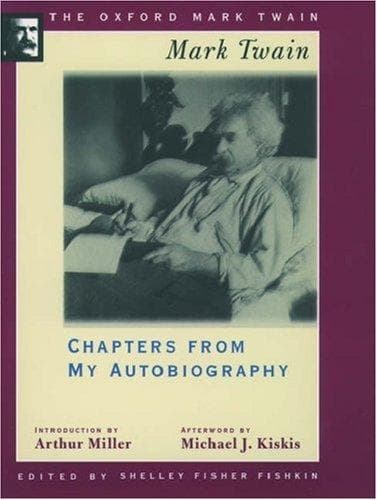
Authors, American -- 19th century -- Biography; Humorists, American -- 19th century -- Biography; Twain, Mark, 1835-1910
[_Dictated in 1904._] A quarter of a century ago I was visiting John Hay
at Whitelaw Reid's house in New York, which Hay was occupying for a few
months while Reid was absent on a holiday in Europe. Temporarily also,
Hay was editing Reid's paper, the New York "Tribune." I remember two
incidents of that Sunday visit particularly well. I had known John Hay a
good many years, I had known him when he was an obscure young editorial
writer on the "Tribune" in Horace Greely's time, earning three or four
times the salary he got, considering the high character of the work
which came from his pen. In those earlier days he was a picture to look
at, for beauty of feature, perfection of form and grace of carriage and
movement. He had a charm about him of a sort quite unusual to my Western
ignorance and inexperience--a charm of manner, intonation, apparently
native and unstudied elocution, and all that--the groundwork of it
native, the ease of it, the polish of it, the winning naturalness of it,
acquired in Europe where he had been Charge d'Affaires some time at the
Court of Vienna. He was joyous and cordial, a most pleasant comrade. One
of the two incidents above referred to as marking that visit was this:
In trading remarks concerning our ages I confessed to forty-two and Hay
to forty. Then he asked if I had begun to write my autobiography, and I
said I hadn't. He said that I ought to begin at once, and that I had
already lost two years. Then he said in substance this:
"At forty a man reaches the top of the hill of life and starts down on
the sunset side. The ordinary man, the average man, not to particularize
too closely and say the commonplace man, has at that age succeeded or
failed; in either case he has lived all of his life that is likely to be
worth recording; also in either case the life lived is worth setting
down, and cannot fail to be interesting if he comes as near to telling
the truth about himself as he can. And he _will_ tell the truth in spite
of himself, for his facts and his fictions will work loyally together
for the protection of the reader; each fact and each fiction will be a
dab of paint, each will fall in its right place, and together they will
paint his portrait; not the portrait _he_ thinks they are painting, but
his real portrait, the inside of him, the soul of him, his character.
Without intending to lie he will lie all the time; not bluntly,
consciously, not dully unconsciously, but half-consciously--
consciousness in twilight; a soft and gentle and merciful twilight which
makes his general form comely, with his virtuous prominences and
projections discernible and his ungracious ones in shadow. His truths
will be recognizable as truths, his modifications of facts which would
tell against him will go for nothing, the reader will see the fact
through the film and know his man.
Public-domain text, read in full here on John Shaqi.
Reviews
Reviews
No reviews yet
Be the first to share your thoughts on this work.
Elsewhere in the archive
Join the Discussion
Join the discussion
Sign in to leave a comment or review.
Sign InorCreate an account