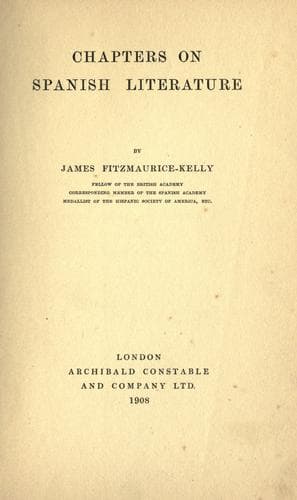
Chapters on Spanish LiteratureFitzmaurice-Kelly, James
History
Chapters on Spanish Literature
Fitzmaurice-Kelly, James
Spanish literature; Spanish literature -- History and criticism
That these are blemishes it would be futile to deny; but how
insignificant they are beside the positive qualities of the Second
Part! Unlike some of his admirers, Cervantes was not above profiting
by criticism. He tells us that objection had been taken to the
intercalated stories of the First Part, and to some scenes of exuberant
fun bordering on horse-play. These faults are avoided in the sequel,
which broadens out till it assumes a truly epical grandeur. The
development of the two central characters is at once more logical and
more poetic; Don Quixote awakens less laughter, and more thought, while
Sancho Panza’s store of apophthegms and immemorial wisdom is more
inexhaustible and apposite than ever. Lastly, the new personages, from
the Duchess downwards to Doctor Pedro Recio de Agüero—the ill-omened
physician of Barataria—are marvels of realistic portraiture. The
presentation of the crazy knight and the droll squire expands into
a splendid pageant of society. And, as one reads the less elaborate
passages, one acquires the conviction that the very dust of Cervantes’s
writings is gold. The Second Part of _Don Quixote_ was the last of
his works that he saw in print. His career was over, and it closed in
splendour. His battle was fought and won, and he died, as befits a
hero, with the trumpets of victory ringing in his ears.
His labyrinthine romance, _Los Trabajos de Persiles y Sigismunda_,
appeared in 1617. Even had this posthumous work been, as Cervantes
half hoped, ‘the best book of its kind,’ it could scarcely have added
to his glory. Though distinctly not the best book of its kind, the
great name on its title-page procured it a respectful reception, and
it was repeatedly reprinted within a short time of its publication.
But it was soon lost in the vast shadow of _Don Quixote_: no one need
feel guilty because he has not read it. The world, leaving scholars
and professional critics to estimate the writer’s indebtedness to
Heliodorus and Achilles Tatius, has steadily refused to be interested
in _Persiles y Sigismunda_; and in the long run the world delivers
a just judgment. It is often led astray by gossip, by influence, by
publishers’ tricks, by authors who press their own wares on you with
all the effrontery of a cheap-jack at a fair; but the world finds
out the truth at last. An author’s genius may be manifest in most or
all of his works; but it is wont to be conspicuous in one above the
rest. Shakespeare wrote _Hamlet_: one _Hamlet_. Cervantes wrote _Don
Quixote_—two _Don Quixotes_: a feat unparalleled in the history of
literature. The one is the foremost of dramatists, and the other the
foremost of romancers: and it is to a single masterpiece that each owes
the greater part of his transcendent fame.
CHAPTER VII
LOPE DE VEGA
Public-domain text, read in full here on John Shaqi.
Reviews
Reviews
No reviews yet
Be the first to share your thoughts on this work.
Elsewhere in the archive
Join the Discussion
Join the discussion
Sign in to leave a comment or review.
Sign InorCreate an account