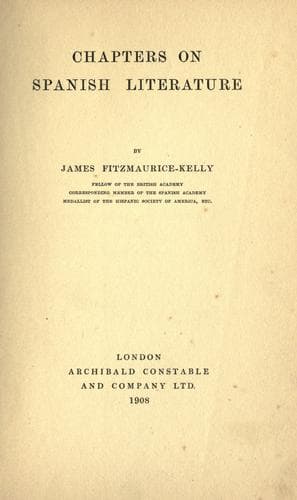
Chapters on Spanish LiteratureFitzmaurice-Kelly, James
History
Chapters on Spanish Literature
Fitzmaurice-Kelly, James
Spanish literature; Spanish literature -- History and criticism
The judges evidently knew their man. He went through the form of
retreating to Valencia, but he had no intention of hiding his talent
under a bushel in the provinces. His next step was astounding in its
insolence: he returned to Madrid, and thence eloped with Isabel de
Urbina y Cortinas, daughter of a king-at-arms. The police were at once
in hot pursuit, but failed to overtake the culprit. He parted from the
lady, was married to her by proxy on May 10, 1588, and nineteen days
later was out of range on the _San Juan_, one of the vessels of the
Invincible Armada. Lope took part in the famous expedition of the ‘sad
Intelligencing Tyrant’ when, as Milton puts it, ‘the very maw of Hell
was ransacked, and made to give up her concealed destruction, ere she
could vent it in that terrible and damned blast.’ Returning from this
disastrous adventure, during which he found time to write the greater
part of _La Hermosura de Angélica_, an epic consisting of eleven
thousand lines, Lope settled at Valencia, and joined the household
of the fifth Duke of Alba. It was the custom of the time for a poor
Spanish gentleman, who would have been disgraced by the adoption of a
trade or business, to serve as secretary to some rich noble: the duties
were various, indefinite and not always dignified, but they involved
no social degradation. Lope’s versatile talents were thus utilised
in succession by the Marqués de Malpica and the Marqués de Sarriá,
afterwards Conde de Lemos (the son-in-law of Lerma, and in later years
the patron of Cervantes).
His introduction to aristocratic society enlarged Lope’s sphere of
observation: it did nothing to improve his morals, which were not
naturally austere. During this period he was writing incessantly for
the stage, and the Spanish stage was not then a school of asceticism.
His wife died about the year 1595, and the last restraint was gone.
Lope was straightway entangled in a series of scandalous amours. He was
prosecuted for criminal conversation with Antonia Trillo de Armenta in
1596, and in 1597 began a love-affair with Micaela de Luján, the Camila
Lucinda of his sonnets, and the mother of his brilliant children, Lope
Félix del Carpio y Luján and Marcela, who inherited no small share of
her father’s improvising genius. It is impossible to palliate Lope’s
misconduct, and the persistent effort to keep it from public knowledge
has damaged him more than the attacks of all his enemies; but it is
fair to remember that he lived in the most corrupt circles of a corrupt
age, that he suffered such temptations as few men undergo, and that he
repeatedly strove to extricate himself from the mesh of circumstance.
Public-domain text, read in full here on John Shaqi.
Reviews
Reviews
No reviews yet
Be the first to share your thoughts on this work.
Elsewhere in the archive
Join the Discussion
Join the discussion
Sign in to leave a comment or review.
Sign InorCreate an account