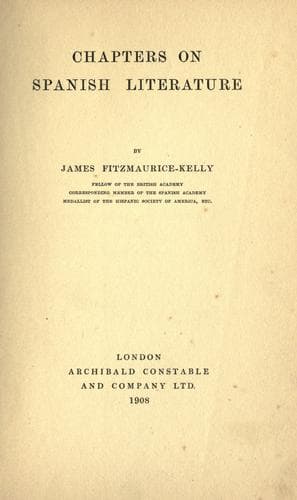
Chapters on Spanish LiteratureFitzmaurice-Kelly, James
History
Chapters on Spanish Literature
Fitzmaurice-Kelly, James
Spanish literature; Spanish literature -- History and criticism
The death of his son Carlos Félix was quickly followed by the death
of his wife, and his devotional mood deepened. He now made an
irreparable mistake by entering holy orders. No man was less fitted to
be a minister of religion, and his private correspondence discloses
no sign of a religious spirit, or of anything resembling a religious
vocation: on the contrary, it reveals him as frequenting loose company,
and cracking unseemly jokes at a most solemn moment. The pendulum
had already begun to swing before his ordination, and for some years
afterwards he was prominent as an unscrupulous libertine. No one
as successful as Lope could fail to make many enemies: he had now
delivered himself into their hands, and assuredly they did not spare
him. In the Preface to the Second Part of _Don Quixote_ Cervantes,
though he does not mention Lope de Vega by name, indulges in an
unmistakable allusion to him as a Familiar of the Inquisition notorious
for his ‘virtuous occupation.’ Yes! a ‘virtuous occupation’ which was
an intolerable public scandal. From 1605 onwards Lope had been on
intimate terms with the Duke of Sesa, and his correspondence with the
Duke is his condemnation. But his conscience was not dead. Among his
letters to Sesa many are stained with tears of shame and of remorse.
They reveal him in every mood. He protests against being made the
intermediary of the Duke’s vulgar gallantries; he forms resolutions to
amend, yet falls, and falls again.
In his fifty-fifth year he conceived an insane passion for Marta
de Nevares Santoyo. On the details of this lamentable intrigue
nothing need be said here. Once more Samson was in the hands of the
Philistines. Led on by Góngora, they showed him no mercy, but he
survived their onset. His plays were acted on every stage in Spain;
the people who flocked to the theatre were spell-bound by his dramatic
creations, his dexterity, grace and wit; his name was used as a synonym
for matchless excellence; and he strengthened his position with the
more learned public by a mass of non-dramatic work. He seldom reaches
such a height as in the _Pastores de Belén_—a perfect gem of devotion
and of art—but the adaptability of his talent is amazing in prose and
verse dealing with subjects as diverse as the triumphs of faith in
Japan and the fate of Mary Queen of Scots. The short stories in the
_Filomena_ and _Circe_ represent him at his weakest, but the _Dorotea_,
a work that had lain by him for many years, is an absorbing fragment
of autobiography which exhibits Lope as a master of graceful and
colloquial diction.
Public-domain text, read in full here on John Shaqi.
Reviews
Reviews
No reviews yet
Be the first to share your thoughts on this work.
Elsewhere in the archive
Join the Discussion
Join the discussion
Sign in to leave a comment or review.
Sign InorCreate an account