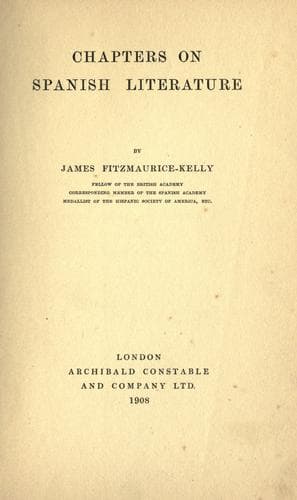
Chapters on Spanish LiteratureFitzmaurice-Kelly, James
History
Chapters on Spanish Literature
Fitzmaurice-Kelly, James
Spanish literature; Spanish literature -- History and criticism
Apart from the popular esteem which he thoroughly deserved, Calderón
was evidently a special favourite with Olivares, who never stinted
Philip in the matter of toys and amusements, and levied a sort of
blackmail (for this purpose) on those whom he nominated to high office.
Great preparations were made for a gorgeous production of _El mayor
encanto amor_ at the Buen Retiro in 1639. The Viceroy of Naples was
induced to make arrangements for a lavish display by the ingenious
stage-machinist, Cosme Lotti. A floating stage was provided lit up with
three thousand lanterns; seated in gondolas, the King and his suite
listened to the performance; and the evening closed with a banquet.
These freakish shows were frequent. In February 1640 we hear of a
stormy scene at a rehearsal, which ended in Calderón’s being wounded.
It is commonly said that he was at work on his _Certamen de amor y
celos_ when the Catalan revolt broke out in 1640, and that he finished
it off hurriedly by a _tour de force_ so as to be able to take the
field. This is a picturesque tale, but, like most other picturesque
tales, it seems to be somewhat doubtful. On May 28, 1640, before the
rebellion began, Calderón enrolled himself in a troop of cuirassiers
raised by Olivares, the Captain-General of the Spanish cavalry; and
he did not actually take his place in the ranks till September 29. He
proved an efficient soldier, was employed on a special mission, and
received promotion. His health, as often happens with those destined to
live long, was never robust, and forced him to resign on November 15,
1642. In 1645 he was granted a military pension of thirty _escudos_ a
month: it was not paid punctually, and he was more than once obliged to
dun the Treasury for arrears.
He had now reached an age when men begin to lose their relatives
and friends. In June 1645 his brother José was killed in action at
Camarasa; his brother Diego died at Madrid on November 20, 1647.
Calderón’s life was generally most correct, but he had his frailties,
and his commerce with the stage exposed him to the occasions of sin.
We do not know who was the mother of his son, Pedro José, but it may
be assumed that she was an actress. She died about 1648-50, soon after
the birth of the boy, who passed as Calderón’s nephew. In 1648 Calderón
was dangerously ill, and in December 1650 he alleged his increasing
age and waning strength as a reason for quitting the King’s service;
he announced his intention of taking orders, and petitioned that his
pension might, nevertheless, be continued. He had already been received
as a Tertiary of St. Francis, and accepted the nomination to the living
(founded by his grandmother in 1612) which he had thought of taking
when he went to Salamanca University, some thirty years earlier. He was
ordained in 1651, and seems to have been an exemplary priest.
Public-domain text, read in full here on John Shaqi.
Reviews
Reviews
No reviews yet
Be the first to share your thoughts on this work.
Elsewhere in the archive
Join the Discussion
Join the discussion
Sign in to leave a comment or review.
Sign InorCreate an account