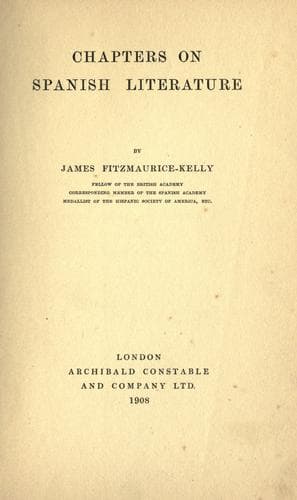
Chapters on Spanish LiteratureFitzmaurice-Kelly, James
History
Chapters on Spanish Literature
Fitzmaurice-Kelly, James
Spanish literature; Spanish literature -- History and criticism
Apart from the composition of _autos_ and _comedias palaciegas_,
Calderón’s life was henceforth uneventful. His position in Spain was
firmly established, but foreigners were sometimes recalcitrant. The
French traveller Bertaut thought little of one of Calderón’s plays
which he saw in 1659, and thought even less of the author whom he
visited later in the day:—‘From his talk, I saw that he did not know
much, though he is quite white-haired. We argued a little concerning
the rules of the drama which they do not know at all, and which they
make game of in that country.’ This seems to have been the average
French view.[101] Chapelain, writing to Carrel de Sainte-Garde on
April 29, 1662, says that he had read an abridgment of a play by
Calderón:—‘par où j’ay connu au moins que si les vers sont bons, son
dessein est très mauvais, et sa conduite ridicule.’ What else could a
champion of the unities think?
Though a priest beyond reproach, Calderón was not left in peace by
busybodies and heresy-hunters. His _auto_ concerning the conversion
of the eccentric Christina of Sweden was forbidden in 1656. Another
_auto_, entitled _Las órdenes militares ó Pruebas del segundo Adán_,
gave rise to no objection when acted before the King on June 8, 1662;
but it was ‘delated’ to the Inquisition, the stage-copies were seized,
and permission to perform it was refused. There can have been no
heresy in this _auto_, for the prohibition was withdrawn nine years
later. On February 18, 1663, Calderón became chaplain to Philip IV.
(a post which carried with it no stipend), and in this same year
he joined the Congregation of St. Peter, of which he was appointed
Superior in 1666. He continued writing _comedias palaciegas_ during the
next reign: _Fieras afemina amor_ and _La Estatua de Prometeo_ were
produced in honour of the Queen-Mother’s birthday in 1675 and 1679
respectively; and _El segundo Escipión_ was played on November 6, 1677,
to commemorate the coming of age of Charles II. On August 24, 1679, an
Order in Council was issued granting Calderón a _ración de cámara en
especie_ on account of his services, great age, and poverty; this is
perplexing, for his will (made twenty-one months later) shows that he
was very comfortably off.
Public-domain text, read in full here on John Shaqi.
Reviews
Reviews
No reviews yet
Be the first to share your thoughts on this work.
Elsewhere in the archive
Join the Discussion
Join the discussion
Sign in to leave a comment or review.
Sign InorCreate an account