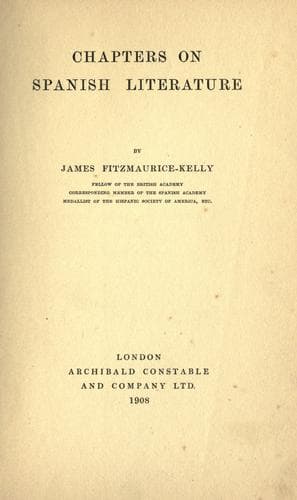
Chapters on Spanish LiteratureFitzmaurice-Kelly, James
History
Chapters on Spanish Literature
Fitzmaurice-Kelly, James
Spanish literature; Spanish literature -- History and criticism
This motley company was dispersed later. In the revised version of
_The Palace of Art Calderón_ finds no place, and the omission causes
no more surprise than the omission of ‘eastern Confutzee.’ He is
admired as a splendid poet and a great dramatist, but we no longer see
him, as Tennyson saw him in 1833, on a sublime and solitary pinnacle
of glory—‘a poetical Melchisedec, without spiritual father, without
spiritual mother, with nothing round him to explain or account for the
circumstances of his greatness.’ As Trench says, there are no such
appearances in literature, and Calderón has ceased to be a mystery or
a miracle. Yet it was not unnatural that those who took the Schlegels
for guides should see him in this light. The fact that the works of
other Spanish dramatists were not easily obtainable necessarily gave
an exaggerated idea of Calderón’s originality and importance, for it
was next to impossible to compare him with his rivals. We are now more
favourably situated. We know—what our grandfathers could not know—that
Friedrich von Schlegel was as wrong as wrong can be when he assured
the world that Calderón was too rich to borrow. In literature no one
is too rich to borrow, and Calderón’s indebtedness to his predecessors
is great. To give but one instance out of many: the Second Act of _Los
Cabellos de Absalón_ is taken bodily from the Third Act of Tirso de
Molina’s sombre and sinister tragedy, _La Venganza de Tamar_.
This was no offence against the prevailing code of morality in literary
matters. Most Spanish dramatists of this period borrowed freely. Lope
de Vega, indeed, had such wealth of invention that he was never tempted
in this way: so, too, he seldom collaborated. So far from being a help,
this division of labour was almost an impediment to him, for he could
write a hundred lines in the time that it took him to consult his
collaborator. But Lope was unique. Manuel de Guerra, in his celebrated
_Aprobación_ to the _Verdadera Quinta Parte_ of Calderón’s plays,
calls him a _monstruo de ingenio_. The words recall the _monstruo de
naturaleza_, the phrase applied by Cervantes to Lope, but there is a
marked difference between the two men—a difference perhaps implied in
the two expressions. Lope was possessed by an irresistible instinct
which impelled him to constant, and often careless, creation; Calderón
creates less lavishly, treats existing themes without scruple, and his
recasts are sometimes completely successful. His devotees never allow
us to forget, for instance, that in _El Alcalde de Zalamea_ he has
transformed one of Lope’s dashing improvisations into a most powerful
drama, and they cite as a parallel case the _Electra_ of Euripides and
the _Electra_ of Sophocles. Just so, when Calderón receives a prize at
the poetical jousts held at Madrid in 1620-22, the extreme Calderonians
are reminded of ‘the boy Sophocles dancing at the festival after the
battle of Salamis.’ Why drag in Sophocles? There are degrees. It is
Public-domain text, read in full here on John Shaqi.
Reviews
Reviews
No reviews yet
Be the first to share your thoughts on this work.
Elsewhere in the archive
Join the Discussion
Join the discussion
Sign in to leave a comment or review.
Sign InorCreate an account