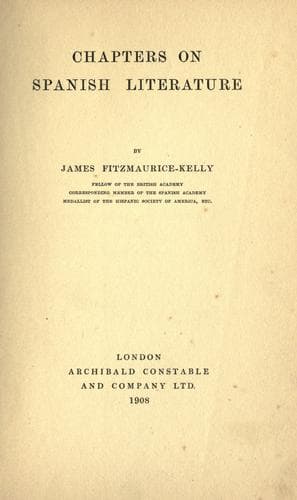
Chapters on Spanish LiteratureFitzmaurice-Kelly, James
History
Chapters on Spanish Literature
Fitzmaurice-Kelly, James
Spanish literature; Spanish literature -- History and criticism
This is not the kind of immortality that any one desires, but this—or
something not much better—is the only kind of immortality that most of
the five hundred are likely to attain. The iniquity of oblivion blindly
scattereth its poppy on the crowd, and the long line closes with
Bancés Candamo, who died in 1704. He was the favourite court-dramatist
as Calderón had been before him. To say that Bancés Candamo occupied
the place once filled by Calderón is to show how greatly the Spanish
theatre had degenerated. No doubt it must have perished in any case,
for institutions die as certainly as men. But its end was hastened by
two most influential personages—one a man of genius, and the other a
fribble—who had the welfare of the stage at heart. By reducing dramatic
composition to a formula, Calderón arrested any possible development;
by lavish expenditure on decorations, Philip IV. imposed his taste
for spectacle upon the public. The public gets what it deserves: when
the stage-carpenter comes in, the dramatist goes out. Compelled to
write pieces which would suit the elaborate scenery provided at the
Buen Retiro, Calderón was the first to suffer. He and Philip,[106]
between them, dealt the Spanish drama its death-blow. It lingered on
in senile decay for fifty years, and with Bancés Candamo it died. It
was high time for it to be gone: for nothing is more lamentable than
the progressive degradation of what has once been a great and living
force.
CHAPTER X
MODERN SPANISH NOVELISTS
Public-domain text, read in full here on John Shaqi.
Reviews
Reviews
No reviews yet
Be the first to share your thoughts on this work.
Elsewhere in the archive
Join the Discussion
Join the discussion
Sign in to leave a comment or review.
Sign InorCreate an account