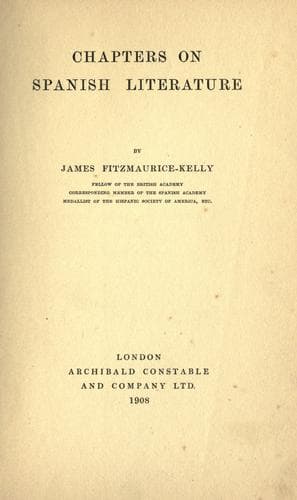
Chapters on Spanish LiteratureFitzmaurice-Kelly, James
History
Chapters on Spanish Literature
Fitzmaurice-Kelly, James
Spanish literature; Spanish literature -- History and criticism
Reyes moros en Castilla entran con gran alarido.[34]
And this is first given by Lorenzo de Sepúlveda who also prints the
original of the next ballad, _The Cid’s Courtship_—
De Rodrigo de Vivar muy grande fama corria.[35]
Upon this follows a translation of a ballad which, says Lockhart,
‘contains some curious traits of rough and antique manners,’ and ‘is
not included in Escobar’s collection.’ The ballad, which Lockhart
entitles _The Cid’s Wedding_, is translated from
A su palacio de Burgos, como buen padrino honrado.[36]
But there is nothing antique about it; it was written in Escobar’s
own time, and appeared first in the _Romancero general_. Nor is there
anything antique in the original of _The Cid and the Leper_—
Ya se parte don Rodrigo, que de Vivar se apellida.[37]
This is first printed by Lorenzo de Sepúlveda, who is also the first to
give
Ya se parte de Toledo ese buen Cid afamado,[38]
which Lockhart, whose version begins at the eleventh line, calls
_Bavieca_. These are, of course, no older than the sixteenth century,
and this is also the date of
A concilio dentro en Roma, á concilio bien llamado,[39]
entitled _The Excommunication of the Cid_ in the English version.
There is a note of disrespect in the original which need cause no
surprise, for our Spanish friends, though incorruptibly orthodox, keep
their religion and their politics more apart than one might think, and
at this very period Charles V. had shown unmistakably that he knew
how to put a Pope in his place as regards temporal matters. But it
need scarcely be said that the Spanish contains nothing equivalent to
Lockhart’s—
The Pope he sitteth above them all, _that they may kiss his toe_—
a Protestant interpolation so grotesque as to be wholly out of keeping
in any Spanish poem.
You will see, then, that most of the Cid ballads translated by Lockhart
are unrepresentative. He might have given us a version of
Dia era de los reyes, dia era señalado[40]—
one of three _romances_[41] which are taken from the same source as the
first in his group—
Cabalga Diego Laínez al buen rey besar la mano.
But the deficiency has been made good by Gibson who notes as a proof of
the ballad’s modernity—it is no older than the sixteenth century—the
inclusion of a passage from the Lara legend—
It was the feast-day of the Kings,
A high and holy day,
Venn all the dames and damosels
The King for hansel pray.
All save Ximena Gomez,
The Count Lozano’s child,
And she has knelt low at his feet,
And cries with dolour wild:
‘My mother died of sorrow, King,
In sorrow still live I;
I see the man who slew my Sire
Each day that passes by.
A horseman on a hunting horse,
With hawk in hand rides he;
And in my dove-cot feeds his bird,
To show his spite at me....
I sent to tell him of my grief,
He sent to threaten me,
That he would cut my skirts away,
Most shameful for to see!
Public-domain text, read in full here on John Shaqi.
Reviews
Reviews
No reviews yet
Be the first to share your thoughts on this work.
Elsewhere in the archive
Join the Discussion
Join the discussion
Sign in to leave a comment or review.
Sign InorCreate an account