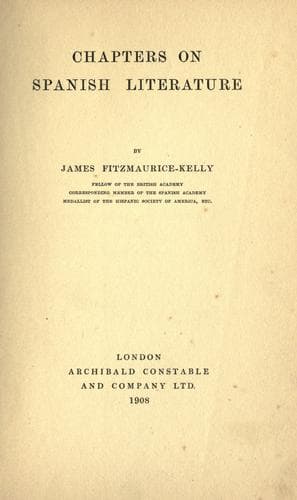
Chapters on Spanish LiteratureFitzmaurice-Kelly, James
History
Chapters on Spanish Literature
Fitzmaurice-Kelly, James
Spanish literature; Spanish literature -- History and criticism
’Tis a right good spear, with a point so sharp, the toughest
plough-share might pierce,
For seven times o’er was it tempered fine, in the blood of a
dragon fierce,
And seven times o’er was it whetted keen, till it shone with
a deadly glance,
For its steel was wrought in the finest forge, in the realm
of mighty France.
Its shaft was made of the Aragon wood, as straight as the straightest
stalk,
And he polished the steel, as he galloped along, on the wings of his
hunting hawk;
‘Don Quadros, thou traitor vile, beware! I’ll slay thee where thou dost
stand,
At the judgment seat, by the Emperor’s side, with the rod of power
in his hand.’
This is more faithful, and consequently more vivid; and the retention
of the Emperor, whom Lockhart (for metrical purposes) reduces to a
King, gives the English reader a useful hint that the ballad belongs to
the Charlemagne series. But its source is obscure, and its symbolism is
as perplexing as symbolism is apt to be.
All who have read _Birds of Passage_—that is to say, everybody who
reads anything—will
remember the black wharves and the slips,
And the sea-tides tossing free;
And Spanish sailors with bearded lips,
And the beauty and mystery of the ships
And the magic of the sea.
These lines are recalled by _Count Arnaldos_, Lockhart’s translation
of the enchanting _romance_ which Longfellow has incorporated in _The
Seaside and the Fireside_[83]:—
¡Quien hubiese tal ventura sobre las aguas del mar,
como hubo el Conde Arnaldos la mañana de san Juan![84]
Probably nine out of every ten readers would turn to the _Buch der
Lieder_ for the loveliest lyric on the witchery of song:—
Die schönste Jungfrau sitzet
Dort oben wunderbar,
Ihr goldnes Geschmeide blitzet,
Sie kämmt ihr goldenes Haar.
Sie kämmt es mit goldenem Kamme,
Und singt ein Lied dabei;
Das hat eine wundersame,
Gewaltige Melodei....
Ich glaube, die Wellen verschlingen
Am Ende Schiffer und Kahn!
Und das hat mit ihrem Singen
Die Lore-Ley gethan.
They may be right, but, if the tenth reader preferred _El
Conde Arnaldos_, I should not think him wrong. Though Heine speaks of
Ein Märchen aus alten Zeiten,
this seems to be a _façon de parler_, for the Lorelei legend was
invented by Clemens Brentano barely twenty years before Heine wrote his
famous ballad. However this may be, in producing his effect of mystic
weirdness the German artist does not eclipse the anonymous Spanish
singer who lived four centuries earlier. This is a bold thing to say;
yet nobody who reads _El Conde Arnaldos_ will think it much too bold.
Passing by a pleasing song (not in the _romance_ form),[85] we come to
the incomplete _Julianesa_ ballad which Lockhart printed, so he tells
us, chiefly because it contained an allusion to the pretty Spanish
custom of picking flowers on St. John’s Day:—
¡Arriba, canes, arriba! ¡que rabia mala os mate![86]
Public-domain text, read in full here on John Shaqi.
Reviews
Reviews
No reviews yet
Be the first to share your thoughts on this work.
Elsewhere in the archive
Join the Discussion
Join the discussion
Sign in to leave a comment or review.
Sign InorCreate an account