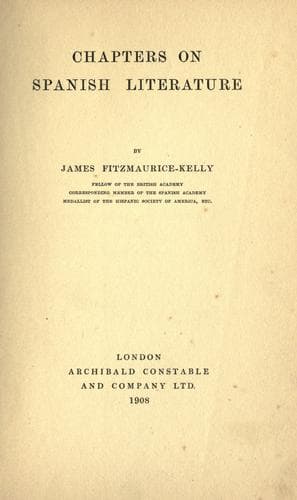
Chapters on Spanish LiteratureFitzmaurice-Kelly, James
History
Chapters on Spanish Literature
Fitzmaurice-Kelly, James
Spanish literature; Spanish literature -- History and criticism
This was Cervantes’s last attempt to escape. His family were doing
what they could to procure his release. They were miserably poor,
and poverty often drives honest people into strange courses. To
excite pity, and so obtain a concession which would help towards
ransoming her son, Cervantes’s mother passed herself off as a widow,
though her husband was still alive, a superfluous old man, now grown
incurably deaf, and with fewer patients than ever. By means of such
dubious expedients some two hundred and fifty ducats were collected
and entrusted to Fray Juan Gil and Fray Antón de la Bella, two monks
engaged in ransoming the Christian slaves at Algiers. The sum was
insufficient. Hassan curtly told Fray Juan Gil that all his slaves
were gentlemen, that he should not part with any of them for less than
five hundred ducats, and that for Jerónimo de Palafox (apparently
an Aragonese of some position) he should ask a ransom of a thousand
ducats. Fray Juan Gil was specially anxious to release Palafox, and
made an offer of five hundred ducats; but Hassan would not abate his
terms. The Dey and the monk haggled from spring till autumn. Hassan
then went out of office, and made ready to leave for Constantinople to
give an account of his stewardship. His slaves were already embarked
on September 19, 1580, when Fray Juan Gil, seeing that there was no
hope of obtaining Palafox’s release by payment of five hundred ducats,
ransomed Cervantes for that sum. It is disconcerting to think that,
if the Trinitarian friar had been able to raise another five hundred
ducats, we might never have had _Don Quixote_. Palafox would have been
set at liberty, while Cervantes went up the Dardanelles to meet a
violent death in a last attempt at flight.
He stepped ashore a free man after five years of slavery, but his
trials in Algiers were not ended. The enigmatic villain of the drama,
Juan Blanco de Paz, had been busy trumping up false charges to be
lodged against Cervantes in Spain. It was a base and despicable act
duly denounced by the biographers; but we have reason to be grateful
to Blanco de Paz, for Cervantes met the charges by summoning eleven
witnesses to character who testified before Fray Juan Gil. Their
evidence proves that Cervantes was recognised as a man of singular
courage, kindliness, piety and virtue; that his authority among his
fellow-prisoners had excited the malicious jealousy of Blanco de
Paz who endeavoured to corrupt some of the witnesses; and—ludicrous
detail!—that the informer had been rewarded for his infamy with a ducat
and a jar of butter. This testimony, recorded by a notary, is confirmed
by the independent evidence of Fray Juan Gil himself, and by Doctor
Antonio de Sosa, a prisoner of considerable importance who answered the
twenty-five interrogatories in writing. The enquiry makes us acquainted
with all the circumstances of Cervantes’s captivity, and shows that
he was universally regarded as an heroic leader by those best able to
judge.
Public-domain text, read in full here on John Shaqi.
Reviews
Reviews
No reviews yet
Be the first to share your thoughts on this work.
Elsewhere in the archive
Join the Discussion
Join the discussion
Sign in to leave a comment or review.
Sign InorCreate an account