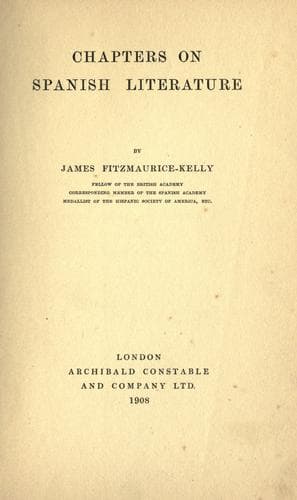
Chapters on Spanish LiteratureFitzmaurice-Kelly, James
History
Chapters on Spanish Literature
Fitzmaurice-Kelly, James
Spanish literature; Spanish literature -- History and criticism
He appears to have obtained his appointment through the influence of
a judge in the High Court of Seville, Diego de Valdivia, a namesake
of the affable captain in _El Licenciado Vidriera_; and, after a few
months’ probation, his appointment was confirmed anew in January 1588.
He had already discovered that there were serious inconveniences
attaching to his post, for he had incurred excommunication for an
irregular seizure of wheat at Écija. It would be tedious to follow him
in his professional visits to the outlying districts of Andalusia.
Everything comes to an end at last—even the equipment of the Invincible
Armada: when the fleet sailed to meet the enemy Cervantes cheered it on
to victory with an enthusiastic ode, and in a second ode he deplored
the great catastrophe. He continued in the public service as commissary
to the galleys, collecting provisions at a salary of twelve _reales_
a day, making Seville his centre, and lodging in the house of Tomás
Gutiérrez. Weary of the sordid life, he applied in 1590 for a post in
America, but failed to obtain it. At the end of the petition, Doctor
Núñez Morquecho wrote: ‘Let him seek some employment hereabouts.’
Blessings on Doctor Núñez Morquecho, the conscientious official! If he
had granted the petitioner’s request, Cervantes might have been more
prosperous, but he would not have written _Don Quixote_. He was forced
to remain where he was, engulfed in arid and vexatious routine.
Still one would imagine that he must have discharged his duties
efficiently, for he was one of four commissaries specially commended to
the King in January 1592 by the new Purveyor-General Pedro de Isunza.
Meanwhile his condition grew rather worse than better: his poverty was
extreme. The financial administration was thoroughly disorganised,
and in 1591 Cervantes had not yet received his salary for 1588. He
seems (not unnaturally) to have lost interest in his work, and to have
become responsible for the indiscreet proceedings of a subordinate at
Teba. Henceforward he was in constant trouble with the authorities.
In August 1592 his accounts were found to be irregular, and his five
sureties were compelled to pay the balance; he was imprisoned at Castro
del Río in September for alleged illegal perquisitioning at Écija,
but was released on appeal. Now and then he was tempted to return to
literature. He signed a contract at Seville early in September 1592
undertaking to furnish the manager, Rodrigo Osorio, with six plays at
fifty ducats apiece: the conditions of the agreement were that Osorio
was to produce each play within twenty days of its being delivered to
him, and that Cervantes was to receive nothing unless the play was ‘one
of the best that had been acted in Spain.’ The imprisonment at Castro
del Río a fortnight later interfered with this project: no more is
heard of it, and Cervantes resumed his work as commissary. Two points
of personal interest are to be noted in the ensuing years: in the
Public-domain text, read in full here on John Shaqi.
Reviews
Reviews
No reviews yet
Be the first to share your thoughts on this work.
Elsewhere in the archive
Join the Discussion
Join the discussion
Sign in to leave a comment or review.
Sign InorCreate an account