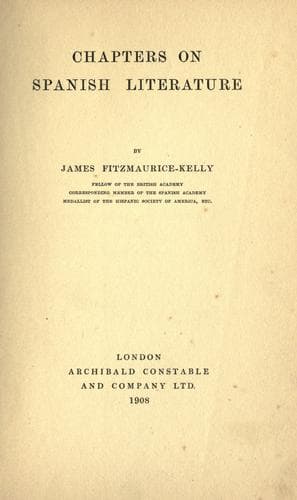
Chapters on Spanish LiteratureFitzmaurice-Kelly, James
History
Chapters on Spanish Literature
Fitzmaurice-Kelly, James
Spanish literature; Spanish literature -- History and criticism
On July 2, 1600, Rodrigo de Cervantes, then an ensign serving under
the Archduke Albert in Flanders, was killed in action; but Miguel de
Cervantes probably did not hear of this till long afterwards. He now
vanishes from sight, for there is another blank in his record from
May 1601 to February 1603. We may assume that he lived in extreme
poverty at Seville, and when next heard of—at Valladolid in 1603—his
circumstances had not greatly improved. His sister Andrea was employed
as needlewoman by the Marqués de Villafranca, and her little bill
is made out in Cervantes’s handwriting: clearly every member of the
family contributed to the household expenses, and every _maravedí_ was
welcome. Presumably Cervantes had come to Valladolid in obedience to a
peremptory _mandamus_ from the Exchequer Court. A brief enquiry must
have convinced the registrars that, with the best will in the world,
he was not in a position to make good the sum which (as they alleged)
was due to the treasury, and they left him in peace for three years
with a cloud over him. He had touched bottom. He had valiantly endured
the buffets of fortune, and was now about to enter into his reward.
His mind to him a kingdom was, and during the years of his disgrace
in Seville he had lived, unhindered by squalid circumstance, in a
pleasaunce of reminiscence and imagination. All other doors being
closed to him, he returned to the house of literature, took pen and
paper, gave literary form to his experiences and imaginings, and, when
drawing on to sixty, produced the masterpiece which has made his name
immortal. It may well be, as he himself hints, that _Don Quixote_ was
begun in Seville jail: perhaps it was finished there. At any rate there
was little to be added to it when the author reached Valladolid in
1603—little beyond the preface and burlesque preliminary verses. By
the summer of 1604 Cervantes had found a publisher, and it had leaked
out that the book contained some caustic references to distinguished
contemporaries. This may account for Lope de Vega’s opinion, expressed
in August 1604 (six months before the work was published), that ‘no
poet is as bad as Cervantes, nor so silly as to praise _Don Quixote_.’
This was not precisely a happy forecast. _Don Quixote_ appeared early
in 1605, was hailed with delight, and received the dubious compliment
of being pirated in Lisbon. Cervantes was the man of the moment, in the
first flush of his popularity, when chance played him an unpleasant
trick. On the night of June 27, 1605, a Navarrese gallant named Gaspar
de Ezpeleta was wounded while in the neighbourhood of the Calle del
Rastro, called for aid at the door of No. 11 where Cervantes lodged,
was helped into the house, and died there two days later. The inmates
were arrested on suspicion, examined by the magistrate, and released
on July 1. The minutes of the examination were unpublished till
recent years, and these furtive tactics gravely injured the memory of
Public-domain text, read in full here on John Shaqi.
Reviews
Reviews
No reviews yet
Be the first to share your thoughts on this work.
Elsewhere in the archive
Join the Discussion
Join the discussion
Sign in to leave a comment or review.
Sign InorCreate an account