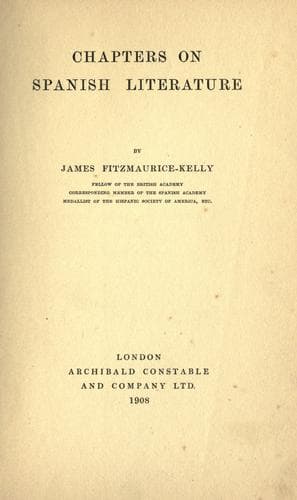
Chapters on Spanish LiteratureFitzmaurice-Kelly, James
History
Chapters on Spanish Literature
Fitzmaurice-Kelly, James
Spanish literature; Spanish literature -- History and criticism
The sixteenth-century prose-pastoral was a barren product, rooted in
a false convention. It was not natural, and it was not artistic: it
failed to reproduce the beauty of the old ideal, and it failed to
create a modern ideal. It satisfies no canon, and to attempt to make a
case for it is to argue for argument’s sake. Had Cervantes continued
to work this vein, he would never have found his true path, and must
have remained an imitator till the end; and it is a mere chance that
he did not return to the pastoral and complete the _Galatea_. It was
far too often in his thoughts. As his butt Feliciano de Silva would
have said, his reason saw ‘the unreason of the reason with which the
reason is afflicted’ when given up to the composition of pastorals;
and yet the pastoral romance had a fascination for him. Fortunately,
he was saved from a fatal error by the fact that, for nearly twenty
years after the publication of the _Galatea_, he was kept against
his will in touch with the realities of life: realities often grim,
squalid, fantastic, cruel and absurd, but preferable to the pointless
philanderings of imaginary swains and nymphs in a pasteboard Arcadia.
The surly taxpayers from whom Cervantes had to wring contributions,
the clergy who excommunicated and imprisoned him, the alcaldes and
jacks-in-office who made his life a burden, the cheating landlords
and strumpets whom he met in miserable inns—these people were not
the crown and flower of the human race, but they were not intangible
abstractions, nor even persistent bores; they were plain men and
women, creatures of flesh and blood, subject to all the passions of
humanity, and using vigorous, natural speech instead of euphemisms and
preciosities. It was by contact with these rugged folk that Cervantes
amassed his wealth of observation, and slowly learned his trade. This
was precisely what he needed. After his return from Algiers, and till
his marriage, circumstances had thrown him into a literary clique,
well-read and well-meaning, but with no vital knowledge of the past
and no intellectual interest in the present. The destiny which drove
Cervantes to collect provisions and taxes in the villages of the south
saved him from the Byzantinism of the capital, and placed him once more
in direct relation with nature—especially human nature. This was his
salvation as an author. And eighteen years later he produced the First
Part of _Don Quixote_.
Public-domain text, read in full here on John Shaqi.
Reviews
Reviews
No reviews yet
Be the first to share your thoughts on this work.
Elsewhere in the archive
Join the Discussion
Join the discussion
Sign in to leave a comment or review.
Sign InorCreate an account