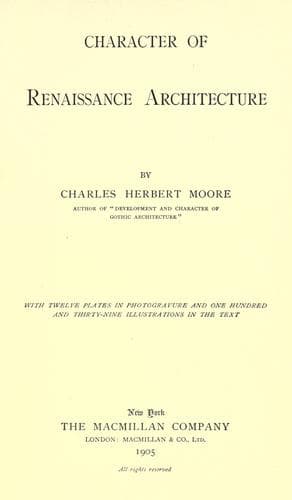
Character of Renaissance ArchitectureMoore, Charles Herbert
History
Character of Renaissance Architecture
Moore, Charles Herbert
Architecture, Renaissance
It may be further remarked concerning De l’Orme’s claim to this column
as his own invention, that it expresses an idea which was at the
bottom of most of the architectural misconceptions and mistakes of
the Renaissance, the idea that architectural excellence may result
from independent personal effort to be original. I think it may be
said that the artistic aberrations of the Renaissance arose largely
from this false notion. The conscious effort to be original in
architecture is inevitably disastrous. The personal contributions of
individuals in architectural development consist of little more than
small improvements on lines of endeavour common to large bodies of men.
The aggregate of such improvements finally become conspicuous, and
mark fundamental changes of architectural styles; but the part of any
individual in such changes is hardly noticeable. Noble architecture has
always been, and must, I think, always be, mainly a social, communal,
and national, not a personal product. De l’Orme failed to consider that
the ancient orders were not inventions of individual designers, but the
outcome of a process of evolution toward which the ingenuity of large
numbers of men through long periods of time had contributed. He thought
that he might himself invent a new order, and call it French. He ought
rather to have called it by his own name, for it was not French in the
sense of being a product of the collective French genius. Had he and
his contemporaries had more discernment, they might have realized that
a true French order was already in existence in that very Gothic art
which they vilified, that the shaft and its load of the twelfth-century
national style was such an order, a true evolution out of the ancient
orders superbly adapted to new conditions.[136]
Public-domain text, read in full here on John Shaqi.
Reviews
Reviews
No reviews yet
Be the first to share your thoughts on this work.
Elsewhere in the archive
Join the Discussion
Join the discussion
Sign in to leave a comment or review.
Sign InorCreate an account