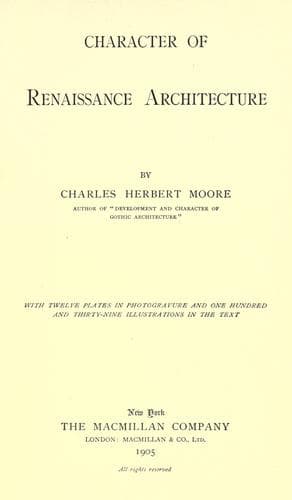
Character of Renaissance ArchitectureMoore, Charles Herbert
History
Character of Renaissance Architecture
Moore, Charles Herbert
Architecture, Renaissance
Du Cerceau, engraving of the Fountain of the Innocents, Paris, 195
(cut);
work of Lescot on the Louvre, 197 (cut);
work of De l’Orme on the Tuileries, 201 (cut), 221^2;
project for the château of Charleval, 209.
Durm, _Die Dom Kuppel in Florenz_, 19^1;
_Die Baukunst der Renaissance in Italien_, 20^1;
cited on domes, 20^1.
East end of the Redentore, Venice, 100, 101.
Elizabethan Art, 216–225 (cuts).
_See_ Renaissance in England.
England, Renaissance in, Architecture of the, 216–246 (cuts).
_See_ Renaissance in England.
Burghley House, chimneys in the form of a Doric order, 217 (cut);
Cranborne Manor-House, porch and façade illustrate Elizabethan
neo-classic ornamentation, 221, 222 (cut);
Hardwick Castle, mention of, 217;
Kirby Hall, façades of the court, 218–220 (cut),
pilasters supporting nothing but miniature pedestals, 219,
window openings said to have been inserted by Inigo Jones,
218,
porch, description of, 220,
its scheme a variation of Lescot’s Louvre pavilions, 220,
gables of Flemish or Dutch origin, 220 (cut);
Longford Castle, 221;
French influence in, 221;
resemblance to château of Chambord, France, 221;
Lower Walterstone Hall, window illustrating Elizabethan
neo-classic ornamentation, 221 (cut);
Stanway House, gatehouse portal, neo-classic features, 223;
Tixall Castle, gatehouse, neo-classic ornamentation, 222;
Westwood Park, porch in the form of a Roman triumphal arch, 223;
Wollaton Hall, neo-classic ornamentation, 223,
chimney-stacks in the semblance of Doric columns, 223,
portal, 224.
Public-domain text, read in full here on John Shaqi.
Reviews
Reviews
No reviews yet
Be the first to share your thoughts on this work.
Elsewhere in the archive
Join the Discussion
Join the discussion
Sign in to leave a comment or review.
Sign InorCreate an account