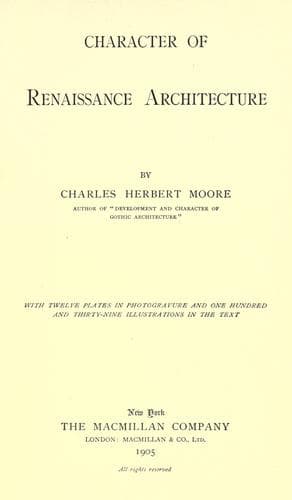
Character of Renaissance ArchitectureMoore, Charles Herbert
History
Character of Renaissance Architecture
Moore, Charles Herbert
Architecture, Renaissance
[43] Some writers have supposed (cf. Middleton, _Ancient Rome_,
Edinburgh, 1885, pp. 338–339) that the dome of the Pantheon is entirely
of concrete, and without thrusts. We have no means of knowing its
exact internal character, but there is reason to believe that it has
some sort of an embedded skeleton of ribs and arches, with concrete
filling the intervals. But if it were wholly of concrete, as Middleton
affirms, it would not be safe without abutment; for, even supposing
that a concrete vault may be entirely free from thrust in a state of
integrity, there is always a chance of ruptures arising from unequal
settlement, which might at once create powerful thrusts. However this
may be, the fact is that the builders of the Pantheon took care to
fortify it with enormous abutment, which would seem to show that they
did not consider it free from thrust.
[44] Michael Angelo’s model, on a large scale and finished in every
detail, is preserved in an apartment of St. Peter’s.
[45] Michael Angelo’s remark, quoted by Fontana (_Tempio
Vaticano_, vol. 2, p. 315): “Imitando l’antico del Pantheon, e
la moderna di Santa Maria del Fiore, corresse i difetti dell’uno, e
dell’altro,” shows that he regarded as a defect the lowness of the
Pantheon dome, which in point of construction is its capital merit,
and that what he proposed to correct in the dome of Florence was its
octagonal form, which is essential to its peculiar structural system.
[46] A consistent exterior for such a vault would not, of course, be
an unbroken drum, though a perfectly Gothic circular vault might be
thus enclosed within a drum. A consistent external form would require
salient buttresses against the lines of thrust, and the intervals
between these buttresses would be open, as in a Gothic apse.
[47] The outside of this vault is figured in my _Development and
Character of Gothic Architecture_, 2d edition. New York and London.
The Macmillan Co., 1900, p. 287.
[48] Cf. my _Development and Character of Gothic Architecture_, p.
70 _et seq._
[49] The turrets, built upon the supporting piers of the interior, give
the outside of the drum the aspect of a massive lantern.
[50] Cf. Poleni, _Memorie Istoriche delle Gran Cupola del Tempio
Vaticano, e de’ Danni di essa, e de’ Ristoramenti loro_ (Padua,
1768), p. 29.
[51] Milizia, _op. cit._, vol. 2, p. 325.
[52] _Parere di tre Mathematici sopra i danni che si sono trovato
nella cupola di S. Pietro sul fine dell’Anno MDCCXLII. Dato per Ordine
di nostro Signore Papa Benedetto XIV_, Rome, 1742.
[53] See Appendix.
[54] “Cominciato forsi poco dopo terminata la fabrica.” _Op.
cit._, p. 13.
[55] _Ibid._, p. 14.
[56] _Ibid._, p. 15.
[57] _Ibid._, p. 19.
[58] _Op. cit._, vol. 2, pp. 327–328.
Public-domain text, read in full here on John Shaqi.
Reviews
Reviews
No reviews yet
Be the first to share your thoughts on this work.
Elsewhere in the archive
Join the Discussion
Join the discussion
Sign in to leave a comment or review.
Sign InorCreate an account