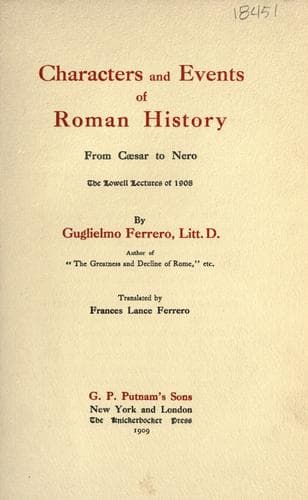
Characters and events of Roman HistoryFerrero, Guglielmo
History
Characters and events of Roman History
Ferrero, Guglielmo
Rome -- History -- Julio-Claudians, 30 B.C.-68 A.D.
The hard conflict of two centuries is sown with tragedies and
catastrophes. Supported by tradition, exasperated by the ever bolder
revolts of woman, the masculine spirit every now and then went mad;
and brutally tore away her costly jewels and tried to deny her soft
raiment and rare perfumes; and when she had already grown accustomed
to appearing in the world and shining there, he willed to drive her
back into the house, and put beside her there on guard the fieriest
threats of law. Sometimes, despairing, he filled Rome with his
laments; protested that the liberty of the woman cost the man too
dear; cried out that the bills of the dressmaker and the jeweller
would send Rome, the Empire, the world, to ruin. In vain, with wealth,
in a civilisation full of Oriental influences, woman grew strong,
rose, and invaded all society, until in the vast Empire of the first
and second centuries, at the climax of her power, with beauty,
love, luxury, culture, prodigality, and mysticism she dominated
and dissolved a society which in the refinements of wealth and
intellectuality had lost the sharp virtues of the pioneer.
It is unnecessary to dilate further on this point; it will be better
rather to dwell a moment on the causes and the effects of this
singular phenomenon. The history of Rome has been and can be so rich,
so manifold, so universal, because in its long record ancient Rome
gathered up into itself, welded, fused, the most diverse elements of
social life, from all peoples and all regions with which it came into
contact. It knew continued war and interrupted peace for centuries.
It held united under its vast sway, states decrepit with the oldest
of civilisations, and peoples hardly out of primitive barbarism.
It exploited with avidity the intelligence, the laboriousness, the
science of the former; the physical force, the war-valour and the
daring of the latter; it absorbed the vices, the habits, the ideas of
the Hellenised Orient, and transfused them in the untamed Occident.
Taking men, ideas, money, everywhere and from every people, it
created first an empire, then a literature, an architecture, an
administration, and a new religion, that were the most tremendous
synthesis of the ancient world. So the Roman world turned out vaster
and more complex than the Greek, although never assuming proportions
exceeding the power of the human mind; and as it grew, it kept that
precious quality, wanting in the Greek, unity; hence, the lucid
clearness of Roman history. There is everything in it, and everything
radiates from one centre, so that comprehension is easy. Without doubt
it would be rash to declare that the history of Rome alone may serve
as the outline of universal history. It is quite likely that there
may be found another history that possesses the same two qualities
for which that of Rome is so notable--universality and unity--but one
thing we may affirm: up to this time the history of Rome alone has
Public-domain text, read in full here on John Shaqi.
Reviews
Reviews
No reviews yet
Be the first to share your thoughts on this work.
Elsewhere in the archive
Join the Discussion
Join the discussion
Sign in to leave a comment or review.
Sign InorCreate an account