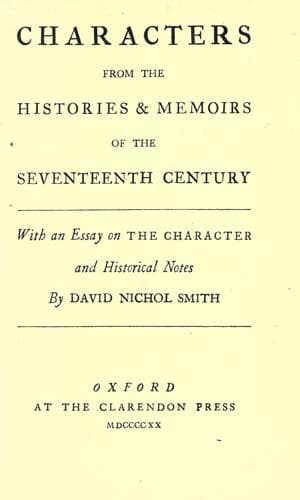
Characters from the Histories & Memoirs of the Seventeenth Century
History
Characters from the Histories & Memoirs of the Seventeenth Century
Great Britain -- Biography; Great Britain -- History -- Stuarts, 1603-1714
Crumwell (though the greatest Dissembler livinge) alwayes made his
hypocrisy of singular use and benefitt to him, and never did any
thinge, how ungratious or imprudent soever it seemed to be, but what
was necessary to the designe; even his roughnesse and unpolishednesse
which in the beginninge of the Parliament he affected, contrary to
the smoothnesse and complacency which his Cozen and bosome frende
M'r Hambden practiced towards all men, was necessary, and his first
publique declaration in the beginninge of the Warr, to his troope when
it was first mustered,--that he would not deceave or cozen them by
the perplexed and involved exspressions in his Commissyon to fight for
Kinge and Parliament, and therfore told them that if the Kinge chanced
to be in the body of the enimy that he was to charge, he woulde as
soone discharge his pistoll upon him, as at any other private person,
and if ther conscience would not permitt them to do the like, he
advized them not to list themselves in his troope or under his
commaunde,--which was generally looked upon, as imprudent and
malicious, and might by the professyons the Parliament then made,
have prooved daungerous to him, yett served his turne, and severed and
united all the furious and incensed men against the goverment, whether
Ecclesiasticall or Civill, to looke upon him as a man for ther turne,
and upon whome they might depende, as one who would go through his
worke that he undertooke; and his stricte and unsociable humour in not
keepinge company with the other officers of the Army in ther jollityes
and excesses, to which most of the superiour officers under the Earle
of Essex were inclined, and by which he often made himselfe ridiculous
or contemptible, drew all those of the like sowre or reserved natures
to his society and conversation, and gave him opportunity to forme
ther understandings, inclinations, and resolutions to his owne modell;
and by this he grew to have a wounderfull interest in the Common
souldyers, out of which, as his authority increased, he made all
his Officers, well instructed how to lyve in the same manner with
ther Souldyers, that they might be able to apply them to ther owne
purposes. Whilst he looked upon the Presbiterian humour as the best
incentive to rebellion, no man more a Presbiterian, he sunge all
Psalmes with them to ther tunes, and looved the longest sermons as
much as they: but when he discover'd, that they would prescribe some
limitts and bounds to ther rebellion, that it was not well breathed,
and would expyre as soone as some few particulars were granted to them
in religion which he cared not for, and then that the goverment must
runn still in the same channell, it concerned him to make it believed,
that the State had bene more Delinquent, then the Church, and that the
people suffer'd more by the civill, then by the Ecclesiasticall power,
and therfore that the change of one would give them little ease, if
Public-domain text, read in full here on John Shaqi.
Reviews
Reviews
No reviews yet
Be the first to share your thoughts on this work.
Elsewhere in the archive
Join the Discussion
Join the discussion
Sign in to leave a comment or review.
Sign InorCreate an account