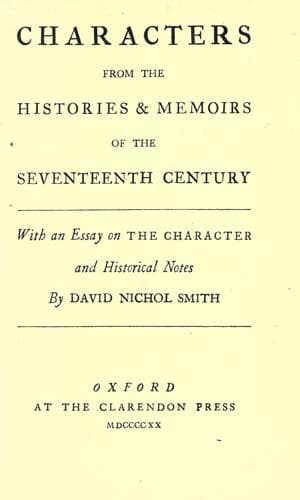
Characters from the Histories & Memoirs of the Seventeenth Century
History
Characters from the Histories & Memoirs of the Seventeenth Century
Great Britain -- Biography; Great Britain -- History -- Stuarts, 1603-1714
And these things made the new modelling of the Army to be resolved
on. But all the Question was how to effect it, without stirring up
the Forces against them which they intended to disband: And all this
was notably dispatcht at once, by One Vote, which was called the
_Self-denying Vote_, viz. That because Commands in the Army had much
pay, and Parliament Men should keep to the Service of the House,
therefore no Parliament Men should be Members of the Army....
When this was done, the next Question was, Who should be Lord General,
and what new Officers should be put in, or old ones continued? And
here the Policy of _Vane_ and _Cromwell_ did its best: For General
they chose Sir _Thomas Fairfax_, Son of the Lord _Ferdinando Fairfax_,
who had been in the Wars beyond Sea, and had fought valiantly in
_Yorkshire_ for the Parliament, though he was over-powered by the Earl
of _Newcastle's_, Numbers. This Man was chosen because they supposed
to find him a Man of no quickness of Parts, of no Elocution, of no
suspicious plotting Wit, and therefore One that _Cromwell_ could make
use of at his pleasure. And he was acceptable to sober Men, because
he was Religious, Faithful, Valiant, and of a grave, sober, resolved
Disposition; very fit for Execution, and neither too Great nor too
Cunning to be Commanded by the Parliament.
41.
SIR HENRY VANE, THE YOUNGER.
_Born 1613. Beheaded 1662._
By CLARENDON.
The other, S'r H. Vane, was a man of greate naturall parts, and of
very profounde dissimulation, of a quicke conception, and very ready
sharpe and weighty exspression. He had an unusuall aspecte, which
though it might naturally proceede both from his father and mother,
nether of which were beautifull persons, yett made men thinke ther was
somewhat in him of extraordinary, and his whole life made good that
imagination. Within a very shorte tyme after he returned from his
studyes in Magdalen Colledge in Oxforde, wher, though he was under the
care of a very worthy Tutour, he lyved not with greate exactnesse, he
spent some little tyme in France, and more in Geneva, and after his
returne into Englande, contracted a full præjudice and bitternesse
against the Church, both against the forme of the goverment and the
lyturgy, which was generally in greate reverence, even with many of
those, who were not frends to the other. In this giddinesse which then
much displeased, or seemed to displease his father, who still appeared
highly conformable, and exceedingly sharpe against those who were not,
he transported himselfe into New Englande, a Colony within few yeeres
before planted by a mixture of all religions, which disposed the
professors to dislike the goverment of the church, who were qualifyed
by the Kings Charter to chuse ther owne goverment and governors, under
the obligation that every man should take the othes of Allegiance and
Supremacy, which all the first planters did, when they receaved ther
charter, before they transported themselves from hence, nor was ther
Public-domain text, read in full here on John Shaqi.
Reviews
Reviews
No reviews yet
Be the first to share your thoughts on this work.
Elsewhere in the archive
Join the Discussion
Join the discussion
Sign in to leave a comment or review.
Sign InorCreate an account