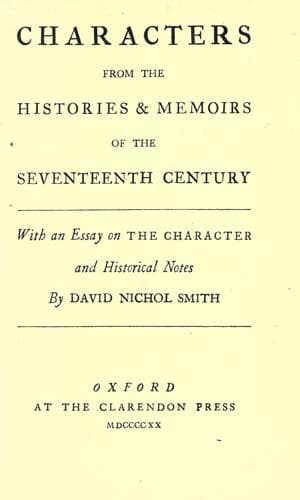
Characters from the Histories & Memoirs of the Seventeenth Century
History
Characters from the Histories & Memoirs of the Seventeenth Century
Great Britain -- Biography; Great Britain -- History -- Stuarts, 1603-1714
The Earle of Essex hath bene enough mentioned before, his nature and
his understandinge have bene described, his former disobligations
from the Courte, and then his introduction into it, and afterwards his
beinge displaced from the office he held in it, have bene sett forth,
and ther will be occasion heareaffter to renew the discource of him,
and therfore it shall suffice in this place to say, that a weake
judgement, and a little vanity, and as much of pryde, will hurry a
man into as unwarrantable and as violent attempts, as the greatest and
most unlimited and insaciable ambition will doe. He had no ambition
of title, or office, or præferment, but only to be kindly looked
upon, and kindly spoken to, and quyetly to injoy his owne fortune, and
without doubte, no man in his nature more abhorred rebellion then he
did, nor could he have bene ledd into it by any open or transparent
temptation, but by a thousand disguises and cozinages. His pryde
supplyed his want of ambition, and he was angry to see any other man
more respected then himselfe, because he thought he deserved it more,
and did better requite it, for he was in his frendshipps just and
constante, and would not have practiced fouly against those he tooke
to be enimyes: no man had creditt enough with him to corrupt him in
pointe of loyalty to the Kinge, whilst he thought himselfe wise enough
to know what treason was. But the new doctrine and distinction of
Allegiance, and of the Kings power in and out of Parliament, and
the new notions of Ordinances, were to hard for him and did really
intoxicate his understandinge, and made him quitt his owne, to follow
thers, who he thought wish'd as well, and judged better then himselfe;
His vanity disposed him to be his Excellence, and his weaknesse to
believe that he should be the Generall in the Houses, as well as in
the Feild, and be able to governe ther councells, and restrayne ther
passyons, as well as to fight ther battles, and that by this meanes
he should become the præserver and not the destroyer of the Kinge and
Kingdome; and with this ill grounded confidence, he launched out into
that Sea, wher he mett with nothinge but rockes, and shelves, and from
whence he could never discover any safe Porte to harbour in.
45.
THE EARL OF SALISBURY.
_William Cecil, second Earl of Salisbury._
_Born 1591. Died 1668._
By CLARENDON.
Public-domain text, read in full here on John Shaqi.
Reviews
Reviews
No reviews yet
Be the first to share your thoughts on this work.
Elsewhere in the archive
Join the Discussion
Join the discussion
Sign in to leave a comment or review.
Sign InorCreate an account