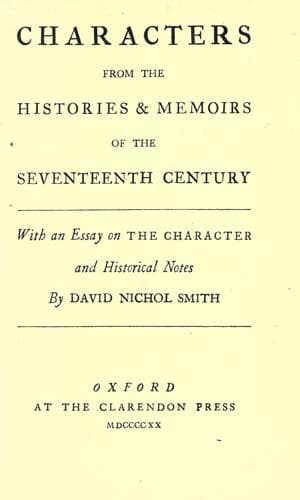
Characters from the Histories & Memoirs of the Seventeenth Century
History
Characters from the Histories & Memoirs of the Seventeenth Century
Great Britain -- Biography; Great Britain -- History -- Stuarts, 1603-1714
Nothinge troubled him more, then the brawles which were growne from
religion, and he therfore exceedingly detested the tyranny of
the church of Rome, more for ther imposinge uncharitably upon the
consciences of other men, then for ther errors in ther owne opinions,
and would often say, that he would renounce the religion of the church
of Englande tomorrow if it oblieged him to believe that any other
Christians should be damned: and that no body would conclude another
man to be damned, who did not wish him so: No man more stricte and
seveare to himselfe, to other men so charitable as to ther opinions,
that he thought that other men were more in faulte, for ther carriage
towards them, then the men themselves were who erred: and he thought
that pryde and passyon more then conscience were the cause of all
separation from each others communion, and he frequently sayd, that
that only kept the world from agreeinge upon such a Lyturgy, as might
bringe them into one communion, all doctrinall points upon which men
differed in ther opinions, beinge to have no place in any Liturgye.
Upon an occasionall discource with a frende of the frequent and
uncharitable reproches of Heretique and Schismatique to lightly
throwne at each other amongst men who differr in ther judgement,
he writt a little discource of Schisme, contayned in lesse then two
sheetes of paper, which beinge transmitted from frende to frende in
writing, was at last without any malice brought to the view of the
Arch-Bishopp of Canterbury Dr. Lawde, who was a very rigid survayour
of all thinges which never so little bordred upon Schisme, and thought
the Church could not be to vigilant against, and jealous of such
incursyons. He sent for M'r Hales, whome when they had both lived in
the University of Oxforde he had knowne well, and told him that he
had in truth believed him to be longe since dead, and chidd him
very kindly, for havinge never come to him, havinge bene of his old
acquaintance, then asked him whether he had lately writt a shorte
discource of Schisme, and whether he was of that opinion which that
discource implyed; he told him, that he had for the satisfaction of a
private frende (who was not of his minde) a yeere or two before,
writt such a small tracte, without any imagination that it would be
communicated, and that he believed it did not contayne any thinge that
was not agreable to the judgement of the primitive fathers; upon which
the Arch-Bishopp debated with him upon some exspressions of Irenæus,
and the most auntient fathers, and concluded with sayinge that the
tyme was very apt to sett new doctrynes on foote, of which the witts
of the Age were to susceptable, and that ther could not be to much
care taken to præserve the peace and unity of the Church, and from
thence asked him of his condition, and whether he wanted any thinge,
and the other answeringe that he had enough, and wanted nor desyred no
addition: and so dismissed him with greate courtesy, and shortly after
Public-domain text, read in full here on John Shaqi.
Reviews
Reviews
No reviews yet
Be the first to share your thoughts on this work.
Elsewhere in the archive
Join the Discussion
Join the discussion
Sign in to leave a comment or review.
Sign InorCreate an account