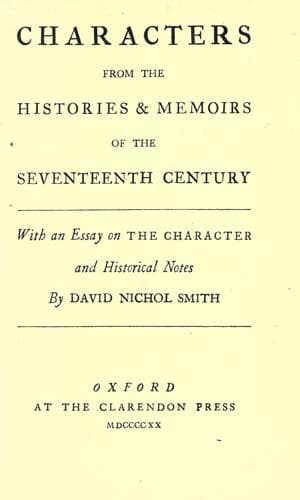
Characters from the Histories & Memoirs of the Seventeenth Century
History
Characters from the Histories & Memoirs of the Seventeenth Century
Great Britain -- Biography; Great Britain -- History -- Stuarts, 1603-1714
weopons of another nature, then were used or knowne in the Church of
Rome when Bellarmyne dyed: and which probably will in tyme undermyne
the very foundation that supportes it.
Such a levity and propensity to change, is commonly attended with
greate infirmityes in, and no lesse reproch and præjudice to the
person, but the sincerity of his hearte was so conspicuous, and
without the least temptation of any corrupt end, and the innocence and
candour of his nature so evident and without any perversenesse, that
all who knew him cleerely decerned, that all those restlesse motions
and fluctuation proceeded only from the warmth and jealosy of his owne
thoughts, in a to nice inquisition for truth: nether the bookes of
the Adversary, nor any of ther persons, though he was acquainted with
the best of both, had ever made greate impression upon him, all his
doubles grew out of himselfe, when he assisted his scruples with all
the strenght of his owne reason, and was then to hard for himselfe;
but findinge as little quyett and repose in those victoryes, he
quickly recover'd by a new appeale to his owne judgement, so that he
was in truth upon the matter in all his Sallyes and retreits his owne
converte, though he was not so totally devested of all thoughts of
this worlde, but that when he was ready for it he admitted some greate
and considerable Churchmen to be sharers with him, in his publique
conversion. Whilst he was in perplexity, or rather some passionate
disinclination to the religion he had bene educated in, he had the
misfortune to have much acquaintance with one M'r Lugar a minister of
that church, a man of a competency of learninge in those points most
contravened with the Romanists, but of no acute parts of witt or
judgement, and wrought so farr upon him, by weakeninge and enervating
those arguments by which he founde he was governed (as he had all the
logique and all the Rhetorique that was necessary to perswade very
powerfully men of the greatest talents) that the poore man, not able
to lyve longe in doubte, to hastily deserted his owne church, and
betooke himselfe to the Roman, nor could all the arguments and reasons
of M'r Chillingworth make him pawse in the exspedition he was usinge,
or reduce him from that Church after he had given himselfe to it, but
had alwayes a greate animosity against him, for havinge (as he sayd)
unkindly betrayed him, and carryed him into another religion, and
ther left him: So unfitt are some constitutions to be troubled with
doubtes, after they are once fixed.
Public-domain text, read in full here on John Shaqi.
Reviews
Reviews
No reviews yet
Be the first to share your thoughts on this work.
Elsewhere in the archive
Join the Discussion
Join the discussion
Sign in to leave a comment or review.
Sign InorCreate an account