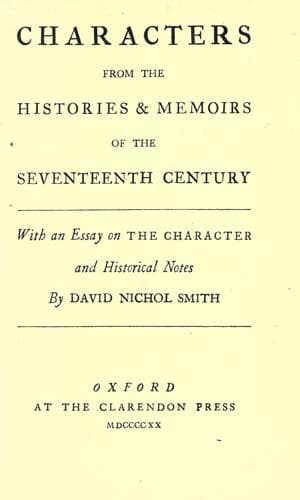
Characters from the Histories & Memoirs of the Seventeenth Century
History
Characters from the Histories & Memoirs of the Seventeenth Century
Great Britain -- Biography; Great Britain -- History -- Stuarts, 1603-1714
His _Affability_ was a Part, and perhaps not the least, of his Wit.
It is a Quality that must not always spring from the Heart, Mens
Pride, as well as their Weakness, maketh them ready to be deceived by
it: They are more ready to believe it a Homage paid to their Merit,
than a Bait thrown out to deceive them. _Princes_ have a particular
Advantage.
There was at first as much of Art as Nature in his Affability, but by
Habit it became Natural. It is an Error of the better hand, but the
_Universality_ taketh away a good deal of the Force of it. A Man
that hath had a kind Look seconded with engaging Words, whilst he is
chewing the Pleasure, if another in his Sight should be just received
as kindly, that Equality would presently alter the Relish: The Pride
of Mankind will have Distinction; till at last it cometh to Smile for
Smile, meaning nothing of either Side; without any kind of Effect;
mere Drawing-room Compliments; the _Bow_ alone would be better without
them. He was under some Disadvantages of this kind, that grew still
in proportion as it came by Time to be more known, that there was less
Signification in those Things than at first was thought.
The Familiarity of his Wit must needs have the Effect of _lessening_
the _Distance_ fit to be kept to him. The Freedom used to him whilst
abroad, was retained by those who used it longer than either they
ought to have kept it, or he have suffered it, and others by their
Example learned to use the same. A King of _Spain_ that will say
nothing but _Tiendro cuydado_, will, to the generality, preserve
more Respect; an Engine that will speak but sometimes, at the same
time that it will draw the Raillery of the Few who judge well, it
will create Respect in the ill-judging Generality. Formality is
sufficiently revenged upon the World for being so unreasonably laughed
at; it is destroyed it is true, but it hath the spiteful Satisfaction
of seeing every thing destroyed with it.
His fine Gentlemanship did him no Good, encouraged in it by being too
much applauded.
His Wit was better suited to his Condition _before_ he was restored
than _afterwards_. The Wit of a Gentleman, and that of a crowned Head,
ought to be different things. As there is a _Crown Law_, there is a
_Crown Wit_ too. To use it with Reserve is very good, and very rare.
There is a Dignity in doing things _seldom_, even without any other
Circumstance. Where Wit will run continually, the Spring is apt to
fail; so that it groweth vulgar, and the more it is practised, the
more it is debased.
Public-domain text, read in full here on John Shaqi.
Reviews
Reviews
No reviews yet
Be the first to share your thoughts on this work.
Elsewhere in the archive
Join the Discussion
Join the discussion
Sign in to leave a comment or review.
Sign InorCreate an account