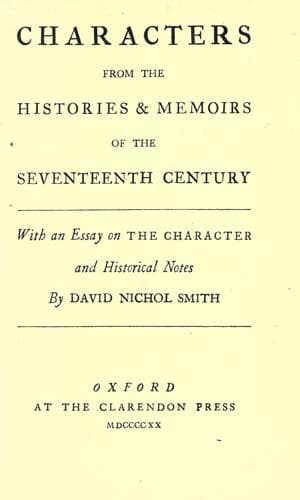
Characters from the Histories & Memoirs of the Seventeenth Century
History
Characters from the Histories & Memoirs of the Seventeenth Century
Great Britain -- Biography; Great Britain -- History -- Stuarts, 1603-1714
and arbitrary government: And yet by a fatal train of passions and
interests he made way for the former, and had almost established
the latter. And, whereas some by a smooth deportment made the first
beginnings of tyranny less discernible and unacceptable, he by the
fury of his behaviour heightned the severity of his ministry, which
was liker the cruelty of an inquisition than the legality of justice.
With all this he was a Presbyterian, and retained his aversion to King
_Charles_ I. and his party to his death.
68.
THE EARL OF SHAFTESBURY.
_Anthony Ashley Cooper, created Earl of Shaftesbury 1662._
_Born 1621. Died 1683._
By BURNET.
The man that was in the greatest credit with the Earl of _Southampton_
was Sir _Anthony Ashly Cooper_, who had married his niece, and
became afterwards so considerable that he was raised to be Earl of
_Shaftsbury_. And since he came to have so great a name, and that I
knew him for many years in a very particular manner, I will dwell a
little longer on his character; for it was of a very extraordinary
composition. He began to make a considerable figure very early. Before
he was twenty he came into the House of Commons, and was on the King's
side; and undertook to get _Wiltshire_ and _Dorsetshire_ to declare
for him: But he was not able to effect it. Yet Prince _Maurice_
breaking articles to a town, that he had got to receive him,
furnished him with an excuse to forsake that side, and to turn to
the Parliament. He had a wonderful faculty in speaking to a popular
assembly, and could mix both the facetious and the serious way of
arguing very agreeably. He had a particular talent to make others
trust to his judgment, and depend on it: And he brought over so many
to a submission to his opinion, that I never knew any man equal to
him in the art of governing parties, and of making himself the head
of them. He was as to religion a Deist at best: He had the dotage of
Astrology in him to a high degree: He told me, that a _Dutch_ doctor
had from the stars foretold him the whole series of his life. But that
which was before him, when he told me this, proved false, if he told
me true: For he said, he was yet to be a greater man than he had
been. He fancied, that after death our souls lived in stars. He had
a general knowledge of the slighter parts of learning, but understood
little to the bottom: So he triumphed in a rambling way of talking,
but argued slightly when he was held close to any point. He had a
wonderful faculty at opposing, and running things down; but had not
the like force in building up. He had such an extravagant vanity in
setting himself out, that it was very disagreeable. He pretended that
_Cromwell_ offered to make him King. He was indeed of great use to
him in withstanding the enthusiasts of that time. He was one of those
who press'd him most to accept of the Kingship, because, as he said
afterwards, he was sure it would ruin him. His strength lay in the
Public-domain text, read in full here on John Shaqi.
Reviews
Reviews
No reviews yet
Be the first to share your thoughts on this work.
Elsewhere in the archive
Join the Discussion
Join the discussion
Sign in to leave a comment or review.
Sign InorCreate an account