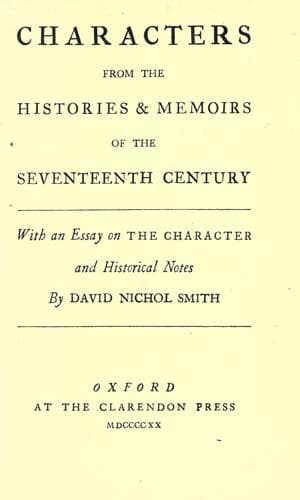
Characters from the Histories & Memoirs of the Seventeenth Century
History
Characters from the Histories & Memoirs of the Seventeenth Century
Great Britain -- Biography; Great Britain -- History -- Stuarts, 1603-1714
Some of their Chiefs were Princes of the Land:
In the first Rank of these did _Zimri_ stand:
A man so various, that he seem'd to be
Not one, but all Mankind's Epitome.
Stiff in Opinions, always in the wrong;
Was Every thing by starts, and Nothing long:
But, in the course of one revolving Moon,
Was Chymist, Fidler, States-Man, and Buffoon:
Then all for Women, Painting, Rhiming, Drinking;
Besides ten thousand Freaks that dy'd in thinking.
Blest Madman, who coud every hour employ,
With something New to wish, or to enjoy!
Railing and praising were his usual Theams;
And both (to shew his Judgment) in Extreams:
So over Violent, or over Civil,
That every Man, with him, was God or Devil.
In squandring Wealth was his peculiar Art:
Nothing went unrewarded, but Desert.
Begger'd by Fools, whom still he found too late:
He had his Jest, and they had his Estate.
He laugh'd himself from Court; then sought Relief
By forming Parties, but could ne'r be Chief:
For, spight of him, the weight of Business fell
On _Absalom_ and wise _Achitophel_:
Thus, wicked but in Will, of Means bereft,
He left not Faction, but of that was left.
72.
THE MARQUIS OF HALIFAX.
_George Savile, created Baron Savile and Viscount Halifax 1668, Earl
of Halifax 1679, Marquis of Halifax 1682._
_Born 1633. Died 1695._
By BURNET.
I name Sir _George Saville_ last, because he deserves a more copious
character. He rose afterwards to be Viscount, Earl, and Marquis of
_Halifax_. He was a man of a great and ready wit; full of life,
and very pleasant; much turned to satyr. He let his wit run much
on matters of religion: So that he passed for a bold and determined
Atheist; tho' he often protested to me, he was not one; and said, he
believed there was not one in the world: He confessed, he could not
swallow down every thing that divines imposed on the world: He was
a Christian in submission: He believed as much as he could, and he
hoped that God would not lay it to his charge, if he could not disgest
iron, as an ostrich did, nor take into his belief things that must
burst him: If he had any scruples, they 20 were not sought for, nor
cherished by him; for he never read an atheistical book. In a fit of
sickness, I knew him very much touched with a sense of religion. I
was then often with him. He seemed full of good purposes: But they
went off with his sickness. He was always talking of morality and
friendship. He was punctual in all payments, and just in all his
private dealings. But, with relation to the publick, he went backwards
and forwards, and changed sides so often, that in conclusion no side
trusted him. He seemed full of Common-wealth notions: Yet he went
into the worst part of King _Charles's_ reign. The liveliness of his
imagination was always too hard for his judgment. A severe jest was
preferred by him to all arguments whatsoever. And he was endless in
consultations: For when after much discourse a point was settled, if
Public-domain text, read in full here on John Shaqi.
Reviews
Reviews
No reviews yet
Be the first to share your thoughts on this work.
Elsewhere in the archive
Join the Discussion
Join the discussion
Sign in to leave a comment or review.
Sign InorCreate an account