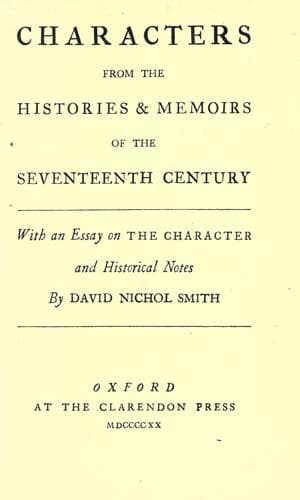
Characters from the Histories & Memoirs of the Seventeenth Century
History
Characters from the Histories & Memoirs of the Seventeenth Century
Great Britain -- Biography; Great Britain -- History -- Stuarts, 1603-1714
JOHN TILLOTSON (1630-94), Archbishop of Canterbury, 1691. EDWARD
STILLINGFLEET (1635-99), Bishop of Worcester, 1689. SIMON PATRICK
(1626-1707), Bishop of Chichester, 1689; Ely, 1691. WILLIAM LLOYD
(1627-1717), Bishop of St. Asaph, 1680; Lichfield, 1692; Worcester,
1700. THOMAS TENISON (1636-1715), Archbishop of Canterbury, 1694.
By BURNET.
With this great accession of wealth there broke in upon the Church a
great deal of luxury and high living, on the pretence of hospitality;
while others made purchases, and left great estates, most of which we
have seen melt away. And with this overset of wealth and pomp, that
came on men in the decline of their parts and age, they, who were
now growing into old age, became lazy and negligent in all the true
concerns of the Church: They left preaching and writing to others,
while they gave themselves up to ease and sloth. In all which sad
representation some few exceptions are to be made; but so few, that,
if a new set of men had not appeared of another stamp, the Church had
quite lost her esteem over the Nation.
These were generally of _Cambridge_, formed under some divines, the
chief of whom were Drs. _Whitchcot_, _Cudworth_, _Wilkins_, _More_,
and _Worthington_. _Whitchcot_ was a man of a rare temper, very mild
and obliging. He had great credit with some that had been eminent in
the late times; but made all the use he could of it to protect good
men of all persuasions. He was much for liberty of conscience: And
being disgusted with the dry systematical way of those times, he
studied to raise those who conversed with him to a nobler set of
thoughts, and to consider religion as a seed of a deiform nature, (to
use one of his own phrases.) In order to this, he set young students
much on reading the ancient Philosophers, chiefly _Plato_, _Tully_,
and _Plotin_, and on considering the Christian religion as a doctrine
sent from God, both to elevate and sweeten humane nature, in which he
was a great example, as well as a wise and kind instructer. _Cudworth_
carried this on with a great strength of genius, and a vast compass
of learning. He was a man of great conduct and prudence: Upon which
his enemies did very falsly accuse him of craft and dissimulation.
_Wilkins_ was of _Oxford_, but removed to _Cambridge_. His first
rise was in the Elector Palatine's family, when he was in _England_.
Afterwards he married _Cromwell_'s sister; but made no other use of
that alliance, but to do good offices, and to cover the University
from the sourness of _Owen_ and _Goodwin_. At _Cambridge_ he joined
with those who studied to propagate better thoughts, to take men off
from being in parties, or from narrow notions, from superstitious
conceits, and a fierceness about opinions. He was also a great
observer and a promoter of experimental philosophy, which was then
a new thing, and much looked after. He was naturally ambitious, but
was the wisest Clergy-man I ever knew. He was a lover of mankind, and
had a delight in doing good.
Public-domain text, read in full here on John Shaqi.
Reviews
Reviews
No reviews yet
Be the first to share your thoughts on this work.
Elsewhere in the archive
Join the Discussion
Join the discussion
Sign in to leave a comment or review.
Sign InorCreate an account