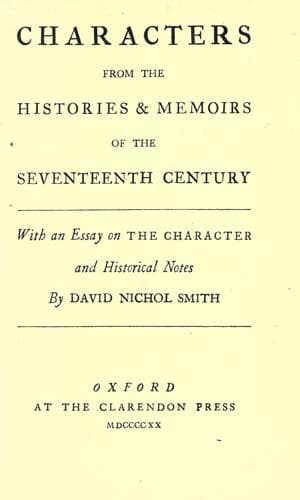
Characters from the Histories & Memoirs of the Seventeenth Century
History
Characters from the Histories & Memoirs of the Seventeenth Century
Great Britain -- Biography; Great Britain -- History -- Stuarts, 1603-1714
against them to decry them as Atheists, Deists, or at best Socinians.
And now that the main principle of religion was struck at by _Hobbs_
and his followers, the Papists acted upon this a very strange part.
They went in so far even into the argument for Atheism, as to publish
many books, in which they affirmed, that there was no certain proofs
of the Christian religion, unless we took it from the authority of the
Church as infallible. This was such a delivering up of the cause
to them, that it raised in all good men a very high indignation at
Popery; that party shewing, that they chose to make men, who would not
turn Papists, become Atheists, rather than believe Christianity upon
any other ground than infallibility.
The most eminent of those, who were formed under those great men I
have mention'd, were _Tillotson_, _Stillingfleet_, and _Patrick_. The
first of these was a man of a clear head, and a sweet temper. He had
the brightest thoughts, and the most correct style of all our divines;
and was esteemed the best preacher of the age. He was a very prudent
man; and had such a management with it, that I never knew any
Clergy-man so universally esteemed and beloved, as he was for above
twenty years. He was eminent for his opposition to Popery. He was no
friend to persecution, and stood up much against Atheism. Nor did
any man contribute more to bring the City to love our worship, than
he did. But there was so little superstition, and so much reason
and gentleness in his way of explaining things, that malice was
long levelled at him, and in conclusion broke out fiercely on him.
_Stillingfleet_ was a man of much more learning, but of a more
reserved, and a haughtier temper. He in his youth writ an _Irenicum_
for healing our divisions, with so much learning and moderation, that
it was esteemed a masterpiece. His notion was, that the Apostles had
settled the Church in a constitution of Bishops, Priests, and Deacons,
but had made no perpetual law about it, having only taken it in,
as they did many other things, from the customs and practice of the
synagogue; from which he inferred, that certainly the constitution
was lawful since authorised by them, but not necessary, since they had
made no settled law about it. This took with many; but was cried out
upon by others as an attempt against the Church. Yet the argument was
managed with so much learning and skill, that none of either side
ever undertook to answer it. After that, he wrote against infidelity,
beyond any that had gone before him. And then he engaged to write
against Popery, which he did with such an exactness and liveliness,
that no books of controversy were so much read and valued, as his
were. He was a great man in many respects. He knew the world well,
and was esteemed a very wise man. The writing of his _Irenicum_ was a
great snare to him: For, to avoid the imputations which that brought
upon him, he not only retracted the book, but he went into the humours
Public-domain text, read in full here on John Shaqi.
Reviews
Reviews
No reviews yet
Be the first to share your thoughts on this work.
Elsewhere in the archive
Join the Discussion
Join the discussion
Sign in to leave a comment or review.
Sign InorCreate an account