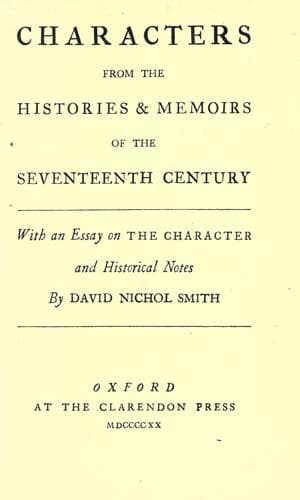
Characters from the Histories & Memoirs of the Seventeenth Century
History
Characters from the Histories & Memoirs of the Seventeenth Century
Great Britain -- Biography; Great Britain -- History -- Stuarts, 1603-1714
Page 65, l. 21. Warwick was member for Radnor in the Long Parliament
from 1640 to 1644. The Bill of Attainder passed the Commons on April
21, 1641, by 204 votes to 59 (Clarendon, ed. Macray, vol. i, p. 306;
Rushworth, _Historical Collections_, third part, vol. i, 1692, p.
225). The names of the minority were posted up at Westminster, under
the heading 'These are Straffordians, Betrayers of their Country'
(Rushworth, _id._, pp. 248-9). There are 56 names, and 'Mr. Warwick'
is one of them.
19.
Clarendon, MS. History, p. 398; _History_, Bk. VI, ed. 1703, vol. ii,
pp. 115-6; ed. Macray, vol. ii, pp. 477-8.
Page 68, l. 5. _Et velut æquali_. The source of this quotation is not
yet found.
l. 15. _the Standard was sett up_, at Nottingham, on August 22, 1642.
l. 17. Robert Greville (1608-43), second Baron Brooke, cousin of Sir
Fulke Greville, first Baron (p. 23, l. 4). See Clarendon, ed. Macray,
vol. ii, pp. 474-5.
l. 27. _all his Children_. Compare Warwick's account of 'that most
noble and stout Lord, the Earle of Northampton', _Mémoires_, pp.
255-7: 'This may be said of him, that he faithfully served his Master,
living and dead; for he left six eminent sons, who were all heirs
of his courage, loyalty, and virtue; whereof the eldest was not then
twenty.'
20.
Clarendon, MS. History, pp. 477-8; _History_, Bk. VII, ed. 1703, vol.
ii, pp. 269-70; ed. Macray, vol. iii, pp. 177-8.
Carnarvon's character has much in common with Northampton's. Though
separated in the _History_, they are here placed together as companion
portraits of two young Royalist leaders who fell early in the Civil
War.
Page 70, l. 21. Dorchester and Weymouth surrendered to Carnarvon on
August 2 and 5, 1643. They were granted fair conditions, but on the
arrival of the army of Prince Maurice care was not taken 'to observe
those articles which had been made upon the surrender of the towns;
which the earl of Carnarvon (who was full of honour and justice upon
all contracts) took so ill that he quitted the command he had with
those forces, and returned to the King before Gloster' (Clarendon,
vol. iii, p. 158).
21.
Clarendon, MS. History, pp. 478-81; _History_, Bk. VII, ed. 1703, vol.
ii, pp. 270-7; ed. Macray, vol. iii, pp. 178-90.
Clarendon wrote two characters of Falkland, the one in 1647 in the
'History' and the other in 1668 in the 'Life'. Both are long, and both
are distinguished by sustained favour of affection and admiration as
well as by wealth of detail. He was aware that the earlier character
was out of scale in a history, but he would not condense it. He even
thought of working it up into a book by itself, wherein he would
follow the example of Tacitus who wrote the _Agricola_ before the
_Annals_ and _Histories_. He corresponded about it with John Earle
(see No. 50). From two of the letters the following extracts are
taken:
Public-domain text, read in full here on John Shaqi.
Reviews
Reviews
No reviews yet
Be the first to share your thoughts on this work.
Elsewhere in the archive
Join the Discussion
Join the discussion
Sign in to leave a comment or review.
Sign InorCreate an account