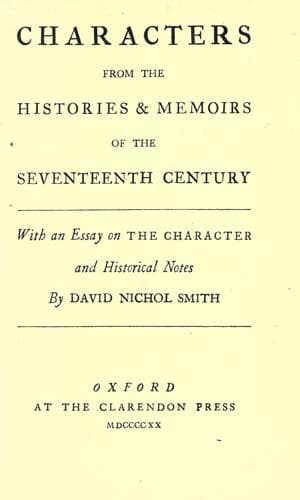
Characters from the Histories & Memoirs of the Seventeenth Century
History
Characters from the Histories & Memoirs of the Seventeenth Century
Great Britain -- Biography; Great Britain -- History -- Stuarts, 1603-1714
PAGE 74, l. 14. _two large discources_. See p. 94, ll. 10-15.
Falkland's _Of the Infallibilitie of the Church of Rome ... Now
first published from a Copy of his owne hand_ had appeared at Oxford
in 1645, two years before Clarendon wrote this passage. It is a
short pamphlet of eighteen quarto pages. It had been circulated in
manuscript during his lifetime, and he had written a _Reply_ to an
_Answer_ to it. The second 'large discource' may be this _Reply_. Or
it may be his _Answer to a Letter of Mr. Mountague, justifying his
change of Religion, being dispersed in many Copies_. Both of these
were first published, along with the _Infallibilitie_, in 1651, under
the editorship of Dr. Thomas Triplet, tutor of the third Viscount,
to whom the volume is dedicated. The dedication is in effect a
character of Falkland, and dwells in particular on his great virtue
of friendship. A passage in it recalls Clarendon. 'And your blessed
Mother', says Triplet, 'were she now alive, would say, she had the
best of Friends before the best of Husbands. This was it that made
_Tew_ so valued a Mansion to us: For as when we went from _Oxford_
thither, we found our selves never out of the Universitie: So we
thought our selves never absent from our own beloved home'.
l. 25. He was Member for Newport in the Isle of Wight in The Short
Parliament, and again in The Long Parliament.
Page 75, l. 5. His father was Controller of the Household before his
appointment as Lord Deputy of Ireland. Cf. p. 91, ll. 3, 4.
l. 18. _L'd Finch_, Sir John Finch (1584-1660), Speaker, Chief Justice
of the Common Pleas, and Lord Keeper, created Baron Finch, 1640. He
was impeached in 1640 and fled to Holland. 'The Lord Falkland took
notice of the business of ship-money, and very sharply mentioned the
lord Finch as the principal promoter of it, and that, being then
a sworn judge of the law, he had not only given his own judgement
against law, but been the solicitor to corrupt all the other judges to
concur with him in their opinion; and concluded that no man ought to
be more severely prosecuted than he' (Clarendon, vol. i, p. 230).
Page 77, l. 26. _haud semper_, Tacitus, _Agricola_, ix.
Page 78, l. 17. _in republica Platonis_, Cicero, _Epis. ad Atticum_,
ii. 1.
l. 20. _it_, i.e. his avoiding them.
l. 30. Sir Harry Vane, the elder, was dismissed from the Secretaryship
of State in November 1641. In an earlier section of the _History_
(vol. i, p. 458) Clarendon claims responsibility for Falkland's
acceptance of the Secretaryship: 'It was a very difficult task to
Mr. Hyde, who had most credit with him, to persuade him to submit to
this purpose of the King cheerfully, and with a just sense of the
obligation, by promising that in those parts of the office which
required most drudgery he would help him the best he could, and would
quickly inform him of all the necessary forms. But, above all, he
prevailed with him by enforcing the ill consequence of his refusal',
&c.
Public-domain text, read in full here on John Shaqi.
Reviews
Reviews
No reviews yet
Be the first to share your thoughts on this work.
Elsewhere in the archive
Join the Discussion
Join the discussion
Sign in to leave a comment or review.
Sign InorCreate an account