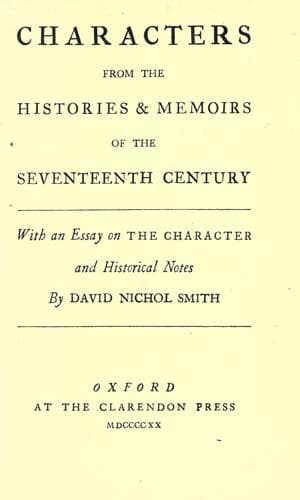
Characters from the Histories & Memoirs of the Seventeenth Century
History
Characters from the Histories & Memoirs of the Seventeenth Century
Great Britain -- Biography; Great Britain -- History -- Stuarts, 1603-1714
l. 17. It is notable that Clarendon nowhere suggests that Falkland was
also a poet. Cowley gives his verses the highest praise in his address
to him on the Northern Expedition (see p. 83, l. 2, note); and they
won him a place in Suckling's _Sessions of the Poets_:
He was of late so gone with Divinity
That he had almost forgot his Poetry,
Though to say the truth (and _Apollo_ did know it)
He might have been both his Priest and his Poet.
His poems were collected and edited by A.B. Grosart in 1871.
23.
Clarendon, MS. Life, p. 55; _Life_, ed. 1759, p. 24.
This very pleasing portrait of Godolphin serves as a pendant to the
longer and more elaborate description of his friend. Clarendon wrote
also a shorter character of him in the _History_ (vol. ii, pp. 457-8).
Page 96, l. 2. _so very small a body_. He is the 'little Cid' (i.e.
Sidney) of Suckling's _Sessions of the Poets_.
PAGE 97, l. 1. He was member for Helston from 1628 to 1643.
l. 6. In the character in the _History_ Clarendon says that he left
'the ignominy of his death upon a place which could never otherwise
have had a mention to the world'. The place was Chagford.
24.
Clarendon, MS. Life, pp. 69-70; _History_, Bk. I, ed. 1702, vol. i,
pp. 69-73; ed. Macray, vol. i, pp. 119-25.
The three characters of Laud here given supplement each other. They
convey the same idea of the man.
Page 97, l. 20. George Abbott (1562-1633), Archbishop of Canterbury,
1611. In the preceding paragraph Clarendon had written an unfavourable
character of him. He 'considered Christian religion no otherwise than
as it abhorred and reviled Popery, and valued those men most who did
that most furiously': 'if men prudently forbore a public reviling
and railing at the hierarchy and ecclesiastical government, let their
opinions and private practice be what it would, they were not only
secure from any inquisition of his, but acceptable to him, and at
least equally preferred by him': his house was 'a sanctuary to the
most eminent of that factious party'. Cf. p. 100, ll. 21-7.
Page 101, l. 2. In the omitted portion Clarendon dealt with the
'Arminianism', as it was then understood in England: 'most of the
popular preachers, who had not looked into the ancient learning, took
Calvin's word for it, and did all they could to propagate his opinions
in those points: they who had studied more, and were better versed
in the antiquities of the Church, the Fathers, the Councils, and the
ecclesiastical histories, with the same heat and passion in preaching
and writing, defended the contrary. But because in the late dispute in
the Dutch churches, those opinions were supported by Jacobus Arminius,
the divinity professor in the university of Leyden in Holland, the
latter men we mentioned were called Arminians, though many of them
had never read a word written by Arminius'. Arminius (the name is the
Latinized form of Harmens or Hermans) died in 1609.
25.
The Church-History of Britain, 1648, Bk. XI, pp. 217-9.
Public-domain text, read in full here on John Shaqi.
Reviews
Reviews
No reviews yet
Be the first to share your thoughts on this work.
Elsewhere in the archive
Join the Discussion
Join the discussion
Sign in to leave a comment or review.
Sign InorCreate an account