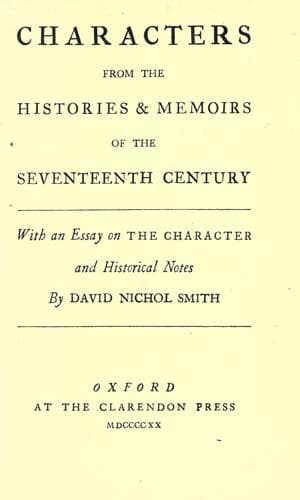
Characters from the Histories & Memoirs of the Seventeenth Century
History
Characters from the Histories & Memoirs of the Seventeenth Century
Great Britain -- Biography; Great Britain -- History -- Stuarts, 1603-1714
Page 168, l. 25. _Earle of Pembroke_, the fourth Earl, Lord
Chamberlain 1626-1641: see p. 4, l. 30, note.
Page 169, l. 3. _Proctour_, in 1631. The 'very witty and sharpe
discourses' are his _Micro-cosmographie_, first published anonymously
in 1628.
l. 23. Compare p. 72, ll. 29 ff., and p. 90, ll. 21 ff.
l. 28. He was made chaplain and tutor to Prince Charles in 1641. His
'lodginge in the court' as chaplain to the Lord Chamberlain had made
him known to the king.
51.
Clarendon, MS. Life, pp. 57-8; _Life_, ed. 1759, pp. 27-8.
'The Ever Memorable Mr. John Hales, of Eaton-Colledge', as he is
called on the title-page of his _Golden Remains_, published in 1659
(second impression, 1673), is probably best known now by his remark
'That there was no subject of which any Poet ever writ, but he would
produce it much better treated of in Shakespeare'. This remark was
first given in print in Dryden's essay _Of Dramatick Poesie_, 1668,
and was repeated in varying forms in Nahum Tate's Dedication to the
_Loyal General_, 1680, Charles Gildon's _Reflections on Mr. Rymer's
Short View of Tragedy_, 1694, and Nicholas Rowe's _Account of the
Life of Shakespear_, 1709. But it had apparently been made somewhere
between 1633 and 1637 in the company of Lord Falkland. It is the one
gem that survives of this retired student's 'very open and pleasant
conversation'.
Clarendon's portrait explains the honour and affection in which the
'ever memorable' but now little known scholar was held by all his
friends. The best companion to it is the life by Wood, _Athenæ
Oxonienses_, ed. Bliss, vol. iv, cols. 409-15. See also John Pearson's
preface to _Golden Remains_.
Page 170, ll. 10 ff. Hales was elected Fellow of Merton College in
1605, and Regius Professor of Greek in 1615. His thirty-two letters to
Sir Dudley Carlton (cf. p. 58, l. 20) reporting the proceedings of the
Synod of Dort, run from November 24, 1618, to February 7, 1619, and
are included in his _Golden Remains_. On his return to England in 1619
he withdrew to his fellowship at Eton.
Sir Henry Savile's monumental edition of the Greek text of St.
Chrysostom, in eight large folio volumes, was published at Eton,
1610-12. Savile was an imperious scholar, but when Clarendon says
that Hales 'had borne all the labour' of this great edition, he can
only mean that Hales had given his assistance at all stages of its
production. In Brodrick's _Memorials of Merton College_, p. 70, it is
stated that Hales was voted an allowance for the help he had given.
Savile was appointed Warden of Merton in 1585 and Provost of Eton in
1596, and continued to hold both posts at the same time till his death
in 1622.
Page 171, ll. 8-12. Compare the verse epistle in Suckling's _Fragmenta
Aurea_, which was manifestly addressed to Hales, though his name is
not given (ed. 1648, pp. 34-5):
Public-domain text, read in full here on John Shaqi.
Reviews
Reviews
No reviews yet
Be the first to share your thoughts on this work.
Elsewhere in the archive
Join the Discussion
Join the discussion
Sign in to leave a comment or review.
Sign InorCreate an account