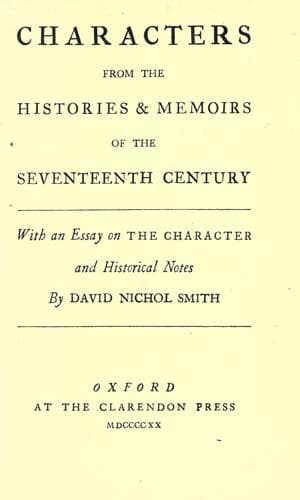
Characters from the Histories & Memoirs of the Seventeenth Century
History
Characters from the Histories & Memoirs of the Seventeenth Century
Great Britain -- Biography; Great Britain -- History -- Stuarts, 1603-1714
Page 177, l. 24. This Engine is described in the narrative of the
siege of Gloucester in Rushworth's _Historical Collections_, ed. 1692,
Part III, vol. ii, p. 290: 'The King's Forces, by the Directions of
Dr. _Chillingworth_, had provided certain Engines, after the manner of
the Roman _Testudines cum Pluteis_, wherewith they intended to Assault
the City between the South and West Gates; They ran upon Cart-Wheels,
with a _Blind_ of Planks Musquet-proof, and holes for four Musqueteers
to play out of, placed upon the Axle-tree to defend the Musqueteers
and those that thrust it forwards, and carrying a Bridge before it;
the Wheels were to fall into the Ditch, and the end of the Bridge to
rest upon the Towns Breastworks, so making several compleat Bridges to
enter the City. To prevent which, the Besieged intended to have made
another Ditch out of their Works, so that the Wheels falling therein,
the Bridge would have fallen too short of their Breastworks into their
wet Mote, and so frustrated that Design.'
ll. 26 ff. Hopton took Arundel Castle on December 9, 1643, and was
forced to surrender on January 6 (Clarendon, vol. iii, pp. 330-5).
Aubrey says that Chillingworth 'dyed of the _morbus castrensis_ after
the taking of Arundel castle by the parliament: wherin he was very
much blamed by the king's soldiers for his advice in military affaires
there, and they curst _that little priest_ and imputed the losse of
the castle to his advice'. (_Brief Lives_, ed. A. Clark, vol. i, p.
172). The chief actor in the final persecution was Francis Cheynell
(1608-65), afterwards intruded President of St. John's College
and Professor of Divinity in the University of Oxford; see his
_Chillingworthi Novissima. Or, the Sicknesse, Heresy, Death, and
Buriall of William Chillingworth (In his own phrase) Clerk of Oxford,
and in the conceit of his fellow Souldiers, the Queens Arch-Engineer,
and Grand-Intelligencer_, 1644.
53.
Clarendon, MS. Life, p. 55; _Life_, ed. 1759, pp. 24, 25.
Weakness of character disguised by ready wit, pleasant discourse,
and charm of manner is Clarendon's judgement on Waller. They had
been friends in their early days when Waller was little more than
an opulent poet who could make a good speech in parliament; but his
behaviour on the discovery of 'Waller's plot', the purpose of which
was to hold the city for the king, his inefficiency in any action
but what was directed to his own safety and advancement, and his
subsequent relations with Cromwell, definitely estranged them.
To Clarendon, Waller is the time-server whose pleasing arts are
transparent. 'His company was acceptable, where his spirit was
odious.' The censure was the more severe because of the part which
Waller had just played at Clarendon's fall. The portrait may be
overdrawn; but there is ample evidence from other sources to confirm
its essential truth.
Public-domain text, read in full here on John Shaqi.
Reviews
Reviews
No reviews yet
Be the first to share your thoughts on this work.
Elsewhere in the archive
Join the Discussion
Join the discussion
Sign in to leave a comment or review.
Sign InorCreate an account