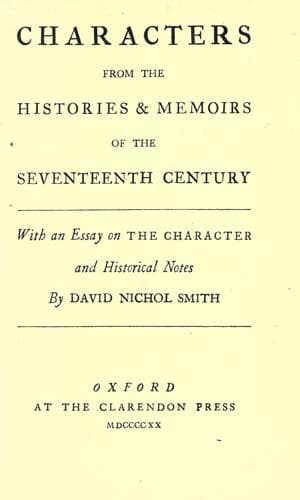
Characters from the Histories & Memoirs of the Seventeenth Century
History
Characters from the Histories & Memoirs of the Seventeenth Century
Great Britain -- Biography; Great Britain -- History -- Stuarts, 1603-1714
It cannot be denyed, that he had in his person, in his aspecte and
countenance, the appearance of a greate man, which he preserved in
his gate and motion. He wore and affected a habitt very different
from that of the tyme, such as men had only beheld in the pictures of
the most considerable men, all which drew the eyes of most and the
reverence of many towards him, as the image and representative of the
primitive nobility, and natife gravity of the nobles, when they had
bene most venerable. But this was only his outsyde, his nature and
true humour beinge so much disposed to levity, and vulgar delights,
which indeede were very despicable and childish: He was never
suspected to love anybody, nor to have the least propensity to
justice, charity, or compassion, so that, though he gott all he
could, and by all the wayes he could, and spent much more then he
gott or had, he was never knowne to give any thinge, nor in all his
imployments (for he had imployments of greate profitt as well as
honour, beinge sent Ambassadour extraordinary into Germany, for the
treaty of that Generall peace, for which he had greate appointments,
and in which he did nothinge of the least importance, and which is
more wounderfull, he was afterwards made Generall of the Army raysed
for Scotlande, and receaved full pay as such, and in his owne office
of Earle Marshall, more money was drawne from the people by his
authority and prætence of jurisdiction, then had ever bene extorted
by all the officers præcedent) yett I say in all his offices and
imployments, never man used, or imployed by him, ever gott any fortune
under him, nor did ever any man acknowledge any obligation to him. He
was rather thought to be without religion, then to inclyne to this
or that party of any. He would have bene a proper instrument for any
tyranny, if he could have a man tyrant enough to have bene advized by
him, and had no other affection for the nation or the kingdome, then
as he had a greate share in it, in which like the greate Leviathan he
might sporte himselfe, from which he withdrew himselfe, as soone as
he decerned the repose therof was like to be disturbed, and dyed in
Italy, under the same doubtfull character of religion, in which he
lyved.
7.
THE EARL OF PEMBROKE.
_William Herbert, third Earl of Pembroke._
_Born 1580. Died 1630._
By CLARENDON.
Public-domain text, read in full here on John Shaqi.
Reviews
Reviews
No reviews yet
Be the first to share your thoughts on this work.
Elsewhere in the archive
Join the Discussion
Join the discussion
Sign in to leave a comment or review.
Sign InorCreate an account