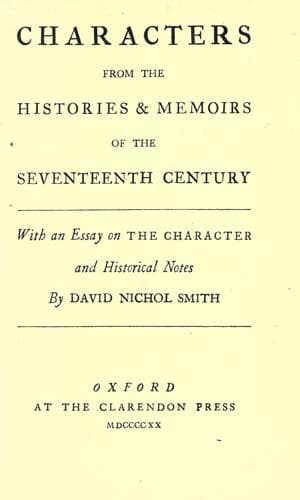
Characters from the Histories & Memoirs of the Seventeenth Century
History
Characters from the Histories & Memoirs of the Seventeenth Century
Great Britain -- Biography; Great Britain -- History -- Stuarts, 1603-1714
Willyam Earle of Pembroke was next, a man of another molde and
makinge, and of another fame and reputation with all men, beinge
the most universally loved and esteemed, of any man of that age, and
havinge a greate office in the courte, made the courte itselfe better
esteemed and more reverenced in the country; and as he had a greate
number of frends of the best men, so no man had ever wickednesse to
avow himselfe to be his enimy. He was a man very well bredd, and of
excellent partes, and a gracefull speaker upon any subjecte, havinge
a good proportion of learninge, and a ready witt to apply it, and
inlarge upon it, of a pleasant and facetious humour and a disposition
affable, generous, and magnificent; he was master of a greate fortune
from his auncestors, and had a greate addition by his wife (another
daughter and heyre of the Earle of Shrewsbury) which he injoyed
duringe his life, shee outlivinge him, but all served not his
exspence, which was only limited by his greate minde, and occasions
to use it nobly; he lyved many yeeres aboute the courte, before in it,
and never by it, beinge rather regarded and esteemed by Kinge James
then loved and favored, and after the fowle fall of the Earle of
Somersett, he was made L'd Chamberlyne of the Kings house more for
the Courtes sake, then his owne, and the Courte appeared with the more
lustre, because he had the goverment of that Province. As he spente
and lived upon his owne fortune, so he stoode upon his owne feete,
without any other supporte then of his proper virtue and meritt, and
lyved towards the favorites with that decency, as would not suffer
them to censure or reproch his Masters judgement and election, but as
with men of his owne ranke. He was exceedingly beloved in the Courte,
because he never desyred to gett that for himselfe, which others
labored for, but was still ready to promote the prætences of worthy
men, and he was equally celebrated in the country, for havinge
receaved no obligations from the courte, which might corrupt or sway
his affections and judgement; so that all who were displeased and
unsatisfyed in the courte or with the Courte, were alwayes inclined
to putt themselves under his banner, if he would have admitted them,
and yett he did not so rejecte them, as to make them choose another
shelter, but so farr to depende on him, that he could restrayn them
from breakinge out beyounde private resentments, and murmurs. He was a
greate lover of his country, and of the religion and justice which he
believed could only supporte it, and his frendshipps were only with
men of those principles; and as his conversation was most with men of
the most pregnant parts and understandinge, so towards any who needed
supporte or encouragement, though unknowne, if fayrely recommended to
him, he was very liberall; and sure never man was planted in a courte,
that was fitter for that soyle, or brought better qualityes with him
to purify that heyre.
Public-domain text, read in full here on John Shaqi.
Reviews
Reviews
No reviews yet
Be the first to share your thoughts on this work.
Elsewhere in the archive
Join the Discussion
Join the discussion
Sign in to leave a comment or review.
Sign InorCreate an account