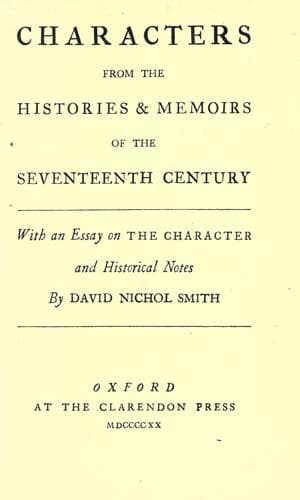
Characters from the Histories & Memoirs of the Seventeenth Century
History
Characters from the Histories & Memoirs of the Seventeenth Century
Great Britain -- Biography; Great Britain -- History -- Stuarts, 1603-1714
He was of a _middling stature_, his countenance had in-dented with
_Age_ before he was old; his _Presence_ grave and comely; of a
high-flying and lively _Wit_, striving in some things to be rather
admired than understood, yet so quick and easie where he would express
himself, and his _Memory_ so strong and active, that he appeared the
_Master_ of a large and plenteous _store-house_ of _Knowledge_, being
(as it were) _Natures Midwife_, stripping her _Callou-brood_, and
clothing them in new _Attire_. His _Wit_ was quick to the last; for
_Gondemar_ meeting him the _Lent_ before his _Censure_, and hearing
of his _Miscarriages_, thought to pay him with his _Spanish Sarcasms_
and _Scoffs_, saying, _My Lord, I wish you a good Easter_; _And you
my Lord_, replyed the _Chancellor_, _a good Passeover_: For he could
neither close with his _English Buffonerie_, nor his _Spanish Treaty_
(which _Gondemar_ knew) though he was so wise as publiquely to oppose
neither. _In fine, he was a fit Jewel to have beautified, and adorned
a flourishing Kingdom, if his flaws had not disgraced the lustre that
should have set him off._
10.
By THOMAS FULLER.
[Sidenote: An essay at his character.]
None can character him to the life, save himself. He was _in parts_,
more than a Man, who in any Liberal profession, might be, whatsoever
he would himself. A great Honourer of _antient Authors_, yet a great
Deviser and Practiser of new waies in Learning. Privy Counsellor,
as to King JAMES, so to _Nature_ it self, diving into many of her
abstruse Mysteries. New conclusions he would _dig out_ with _mattocks_
of _gold & silver_, not caring what his experience cost him, expending
on the _Trials of Nature_, all and more than he got by the _Trials at
the Barre_, Posterity being the better for his, though he the worse
for his own, dear experiments. He and his Servants had _all in
common_, the _Men_ never wanting what their _Master_ had, and thus
what came _flowing_ in unto him, was sent _flying_ away from him, who,
in giving of rewards knew no _bounds_, but the _bottome_ of his own
purse. Wherefore when King James heard that he had given _Ten pounds_
to an _under-keeper_, by whom He had sent him a _Buck_, the King said
merrily, _I and He shall both die Beggars_, which was condemnable
Prodigality in a _Subject_. He lived many years after, and in his
Books will ever survive, in the reading whereof, modest Men commend
him, in what they doe, condemn themselves, in what they doe not
understand, as believing the fault in their own eyes, and not in the
object.
11.
By WILLIAM RAWLEY.
Public-domain text, read in full here on John Shaqi.
Reviews
Reviews
No reviews yet
Be the first to share your thoughts on this work.
Elsewhere in the archive
Join the Discussion
Join the discussion
Sign in to leave a comment or review.
Sign InorCreate an account