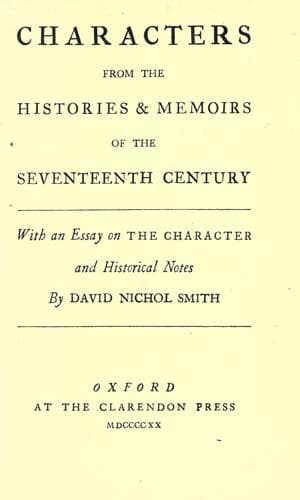
Characters from the Histories & Memoirs of the Seventeenth Century
History
Characters from the Histories & Memoirs of the Seventeenth Century
Great Britain -- Biography; Great Britain -- History -- Stuarts, 1603-1714
Ben Johnsons name can never be forgotten, havinge by his very good
learninge, and the severity of his nature, and manners, very much
reformed the Stage and indeede the English poetry it selfe; his
naturall advantages were judgement to order and governe fancy,
rather then excesse of fancy, his productions beinge slow and upon
deliberation, yett then aboundinge with greate witt and fancy, and
will lyve accordingly, and surely as he did exceedingly exalte the
English language, in eloquence, propriety, and masculyne exspressions,
so he was the best judge of, and fittest to prescribe rules to poetry
and poetts, of any man who had lyved with or before him, or since, if
M'r Cowly had not made a flight beyounde all men, with that modesty
yett to own much of his to the example and learninge of Ben. Johnson:
His conversation was very good and with the men of most note, and he
had for many yeares an extraordinary kindnesse for M'r Hyde, till he
founde he betooke himselfe to businesse, which he believed ought never
to be preferred before his company: He lyved to be very old, and till
the Palsy made a deepe impression upon his body and his minde.
13.
By JAMES HOWELL.
_To Sir THO. HAWK. Knight_.
Sir,
I was invited yesternight to a solemne supper by _B.I._ wher you
were deeply remembred, ther was good company, excellent chear, choice
wines, and joviall welcom; one thing interven'd which almost spoyld
the relish of the rest, that _B._ began to engross all the discourse,
to vapour extremely of himself, and by villifying others to magnifie
his owne _muse_; _T. Ca._ buz'd me in the eare, that though _Ben_
had barreld up a great deal of knowledg, yet it seems he had not
read the _Ethiques_, which among other precepts of morality forbid
self-commendation, declaring it to be an ill favourd solecism in good
manners; It made me think upon the Lady (not very young) who having a
good while given her guests neat entertainment, a capon being brought
upon the table, instead of a spoon she took a mouthfull of claret and
spouted it into the poope of the hollow bird; such an accident happend
in this entertainment you know--_Proprio laus sordet in ore; be a mans
breath never so sweet, yet it makes ones prayses stink, if he makes
his owne mouth the conduit pipe of it_; But for my part I am content
to dispense with this _Roman_ infirmity of _B._ now that time hath
snowed upon his pericranium. You know _Ovid_, and (your) _Horace_ were
subject to this humour, the first bursting out into,
_Tamq; opus exegi quod nec Iovis ira, nec ignis_, &c.
The other into,
_Exegi monumentum ære perennius_, &c.
Public-domain text, read in full here on John Shaqi.
Reviews
Reviews
No reviews yet
Be the first to share your thoughts on this work.
Elsewhere in the archive
Join the Discussion
Join the discussion
Sign in to leave a comment or review.
Sign InorCreate an account