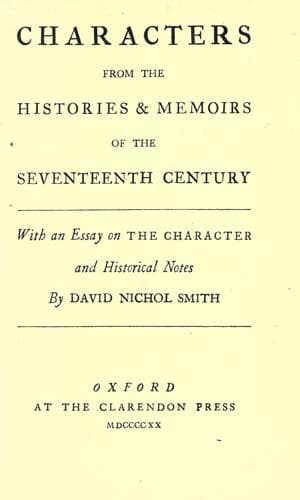
Characters from the Histories & Memoirs of the Seventeenth Century
History
Characters from the Histories & Memoirs of the Seventeenth Century
Great Britain -- Biography; Great Britain -- History -- Stuarts, 1603-1714
He was a person, tho' born sickly, yet who came thro' temperance and
exercise, to have as firm and strong a body, as most persons I ever
knew, and throughout all the fatigues of the warr, or during his
imprisonment, never sick. His appetite was to plain meats, and tho'
he took a good quantity thereof, yet it was suitable to an easy
digestion. He seldom eat of above three dishes at most, nor drank
above thrice: a glasse of small beer, another of claret wine, and
the last of water; he eat suppers as well as dinners heartily; but
betwixt meales, he never medled with any thing. Fruit he would eat
plentifully, and with this regularity, he moved as steddily, as a star
follows its course. His deportment was very majestick; for he would
not let fall his dignity, no not to the greatest Forraigners, that
came to visit him and his Court; for tho' he was farr from pride,
yet he was carefull of majestie, and would be approacht with respect
and reverence. His conversation was free, and the subject matter of
it (on his own side of the Court) was most commonly rational; or if
facetious, not light. With any Artist or good Mechanick, Traveller, or
Scholar he would discourse freely; and as he was commonly improved by
them, so he often gave light to them in their own art or knowledge.
For there were few Gentlemen in the world, that knew more of useful
or necessary learning, than this Prince did: and yet his proportion of
books was but small, having like Francis the first of France, learnt
more by the ear, than by study. His way of arguing was very civil and
patient; for he seldom contradicted another by his authority, but
by his reason: nor did he by any petulant dislike quash another's
arguments; and he offered his exception by this civill introduction,
_By your favour, Sir, I think otherwise on this or that ground_: yet
he would discountenance any bold or forward addresse unto him. And
in suits or discourse of busines he would give way to none abruptly
to enter into them, but lookt, that the greatest Persons should in
affairs of this nature addresse to him by his proper Ministers, or
by some solemn desire of speaking to him in their own persons. His
exercises were manly; for he rid the great horse very well; and on
the little saddle he was not only adroit, but a laborious hunter or
field-man: and they were wont to say of him, that he fail'd not to do
any of his exercises artificially, but not very gracefully; like some
well-proportion'd faces, which yet want a pleasant air of countenance.
He had a great plainnes in his own nature, and yet he was thought even
by his Friends to love too much a versatile man; but his experience
had thorowly weaned him from this at last.
Public-domain text, read in full here on John Shaqi.
Reviews
Reviews
No reviews yet
Be the first to share your thoughts on this work.
Elsewhere in the archive
Join the Discussion
Join the discussion
Sign in to leave a comment or review.
Sign InorCreate an account