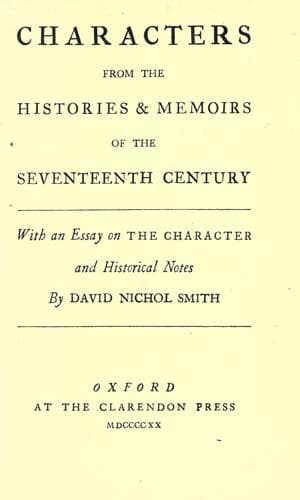
Characters from the Histories & Memoirs of the Seventeenth Century
History
Characters from the Histories & Memoirs of the Seventeenth Century
Great Britain -- Biography; Great Britain -- History -- Stuarts, 1603-1714
particular natures, and into their private conversation, saying,
_These smaller things would discover the men, whilst their great
actions only discover the power of their States._
One or two things more then I may warrantably observe: First, as
an evidence of his natural probity, whenever any young Nobleman or
Gentleman of quality, who was going to travell, came to kiss his hand,
he cheerfully would give them some good counsel, leading to morall
virtue, especially to good conversation; telling them, that _If he
heard they kept good company abroad, he should reasonably expect, they
would return qualified to serve him and their Country well at home_;
and he was very carefull to keep the youth in his times uncorrupted.
This I find in the Mémoires upon James Duke Hamilton, was his advice
unto that noble and loyal Lord, William, afterwards, Duke Hamilton,
who so well serv'd his Son, and never perfidiously disserv'd him, when
in armes against him. Secondly, his forementioned intercepted letters
to the Queen at Naisby had this passage in them, where mentioning
religion, he said, _This is the only thing, wherein we two differ_;
which even unto a miscreant Jew would have bin proofe enough of this
King's sincerity in his religion; and had it not bin providence or
inadvertence, surely those, who had in this kind defam'd him, would
never themselves have publish'd in print this passage, which thus
justified him.
This may be truly said, That he valued the Reformation of his own
Church, before any in the world; and was as sensible and as knowing
of, and severe against, the deviations of Rome from the primitive
Church, as any Gentleman in Christendom; and beyond those errors, no
way quarrelsom towards it: for he was willing to give it its due, that
it might be brought to be willing to accept, at least to grant, such
an union in the Church, as might have brought a free and friendly
communion between Dissenters, without the one's totall quitting his
errors, or the other's being necessitated to partake therein: and I
truly believe this was the utmost both of his and his Archbishop's
inclinations; and if I may not, yet both these Martyrs confessions on
the scaffold (God avert the prophecy of the last, _Venient Romani_)
surely may convince the world, that they both dyed true Assertors of
the Reformation. And the great and learned light of this last age,
Grotius, soon discern'd this inclination in him: for in his dedication
of his immortal and scarce ever to be parallel'd book, _De Jure Belli
& Pacis_, he recommends it to Lewis XIII, King of France, as the most
Royall and Christian design imaginable for his Majestic to become a
means to make an union amongst Christians in profession of religion;
and therein he tells him, how well-knowing and well-disposed the King
of England was thereunto. In a word, had he had as daring and active
a courage to obviate danger; as he had a steddy and undaunted in all
Public-domain text, read in full here on John Shaqi.
Reviews
Reviews
No reviews yet
Be the first to share your thoughts on this work.
Elsewhere in the archive
Join the Discussion
Join the discussion
Sign in to leave a comment or review.
Sign InorCreate an account