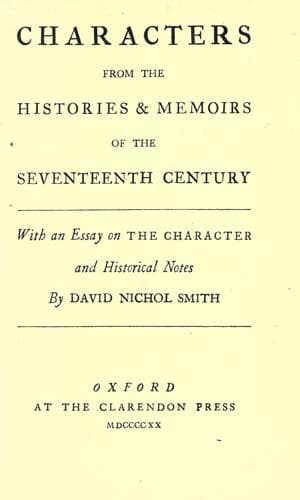
Characters from the Histories & Memoirs of the Seventeenth Century
History
Characters from the Histories & Memoirs of the Seventeenth Century
Great Britain -- Biography; Great Britain -- History -- Stuarts, 1603-1714
Some sharpe expressions he used against the Arch-Bishopp of
Canterbury, and his concurringe in the first Bill to take away the
Votes of Bishopps in the house of Peeres, gave occasyon to some to
believe, and opportunity to others to conclude and publish that he
was no frende to the Church, and the established goverment of it,
and troubled his very frends much, who were more confident of the
contrary, then præpared to answer the allegations. The truth is,
he had unhappily contracted some præjudice to the Arch-Bishopp, and
havinge only knowne him enough, to observe his passyon, when it may
be multiplicity of businesse or other indisposition had possessed
him, did wish him lesse intangled and ingaged in the businesse
of the Courte or State, though, I speake it knowingly, he had a
singular estimation and reverence of his greate learninge and
confessed integrity, and really thought his lettinge himselfe to
those expressyons which implyed a disesteeme of him, or at least an
acknowledgement of his infirmityes, would inable him to shelter him
from parte of the storme he saw raysed for his destruction, which he
abominated with his soule. The givinge his consent to the first Bill
for the displacinge the Bishopps, did proceede from two groundes, the
first, his not understandinge the originall of ther right and suffrage
ther, the other, an opinion that the combination against the whole
goverment of the Church by Bishopps, was so violent and furious, that
a lesse composition then the dispencinge with ther intermedlinge in
sæcular affayres would not præserve the Order, and he was perswaded to
this, by the profession of many persons of Honour, who declared they
did desyre the one, and would then not presse the other, which in that
particular misledd many men; but when his observation and experience
made him discerne more of ther intencions then he before suspected,
with greate frankenesse he opposed the secound Bill that was præferred
for that purpose; and had without scruple the order it selfe in
perfecte reverence, and thought too greate encouragement could not
possibly be given to learninge, nor too greate rewardes to learned
men, and was never in the least degree swayed or moved by the
objections which were made against that goverment, holdinge them
most ridiculous, or affected to the other which those men fancyed to
themselves.
Public-domain text, read in full here on John Shaqi.
Reviews
Reviews
No reviews yet
Be the first to share your thoughts on this work.
Elsewhere in the archive
Join the Discussion
Join the discussion
Sign in to leave a comment or review.
Sign InorCreate an account