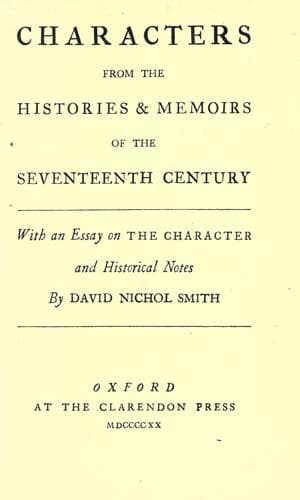
Characters from the Histories & Memoirs of the Seventeenth Century
History
Characters from the Histories & Memoirs of the Seventeenth Century
Great Britain -- Biography; Great Britain -- History -- Stuarts, 1603-1714
From the entrance into this unnaturall warr, his naturall
cheerefulnesse and vivacity grew clowded, and a kinde of sadnesse and
dejection of spiritt stole upon him, which he had never bene used to,
yet, beinge one of those who believed that one battell would end all
differences, and that ther would be so greate a victory on one syde,
that the other would be compelled to submitt to any conditions from
the victor (which supposition and conclusion generally sunke into the
mindes of most men, prævented the lookinge after many advantages which
might then have bene layd hold of) he resisted those indispositions,
et in luctu bellum inter remedia erat: but after the Kings returne
from Brayneforde, and the furious resolution of the two houses, not
to admitt any treaty for peace, those indispositions which had before
touched him, grew into a perfecte habitt of uncheerefulnesse, and he
who had bene so exactly unreserved and affable to all men, that his
face and countenance was alwayes present and vacant to his company,
and held any clowdinesse, and lesse pleasantnesse of the visage,
a kinde of rudenesse or incivillity, became on a suddayne lesse
communicable, and thence very sadd, pale, and exceedingly affected
with the spleene. In his clothes and habitt, which he had intended
before alwayes with more neatenesse, and industry, and exspence, then
is usuall to so greate a minde, he was not now only incurious, but
too negligent, and in his reception of suitors and the necessary or
casuall addresses to his place so quicke, and sharpe, and seveare,
that ther wanted not some men (who were strangers to his nature and
disposition) who believed him prowde and imperious, from which no
mortall man was ever more free. The truth is, as he was of a most
incomparable gentlenesse, application, and even a demisnesse and
submissyon to good, and worthy, and intire men, so he was naturally
(which could not but be more evident in his place which objected him
to another conversation, and intermixture, then his owne election had
done) adversus males injucundus, and was so ill a dissembler of his
dislike, and disinclination to ill men, that it was not possible for
such not to discerne it; ther was once in the house of Commons such a
declared acceptation of the good service an eminent member had done to
them, and as they sayd, to the whole kingdome, that it was mooved, he
beinge present, that the Speaker might in the name of the whole house
give him thankes, and then that every member might as a testimony
of his particular acknowledgement stirr or moove his Hatt towards
him, the which (though not ordred) when very many did, the L'd of
Falkelande (who believed the service itselfe not to be of that moment,
and that an Honourable and generous person could not have stooped to
it, for any recompence) insteede of moovinge his Hatt, stretched both
his Armes out, and clasped his hands togither upon the Crowne of his
Hatt, and held it close downe to his heade, that all men might see
Public-domain text, read in full here on John Shaqi.
Reviews
Reviews
No reviews yet
Be the first to share your thoughts on this work.
Elsewhere in the archive
Join the Discussion
Join the discussion
Sign in to leave a comment or review.
Sign InorCreate an account