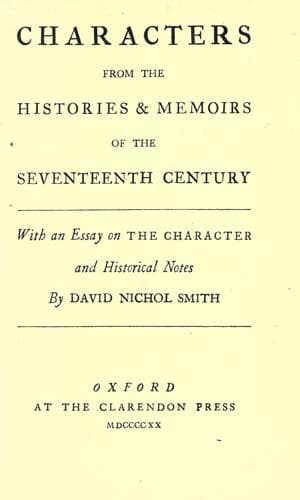
Characters from the Histories & Memoirs of the Seventeenth Century
History
Characters from the Histories & Memoirs of the Seventeenth Century
Great Britain -- Biography; Great Britain -- History -- Stuarts, 1603-1714
The Arch-Bishopp had all his life eminently opposed Calvins doctryne
in those contraversyes, before the name of Arminius was taken notice
of or his opinions hearde of; and therupon for wante of another name
they had called him a Papiste, which nobody believed him to be, and
he had more manifested the contrary in his disputations and writings,
then most men had done: and it may be the other founde the more
seveare and rigourous usage from him, for ther propagatinge that
calumny against him. He was a man of greate courage and resolution,
and beinge most assured within himselfe that he proposed no end in all
his actions or designes, then what was pyous and just (as sure no
man had ever a hearte more intire, to the Kinge, the Church, or his
country) he never studyed the best wayes to those ends; he thought it
may be, that any arte or industry that way, would discreditt, at least
make the integrity of the end suspected: let the cause be what it
will, he did courte persons to little, nor cared to make his designes
and purposes appeare as candid as they were, by shewinge them in any
other dresse, then ther owne naturall beauty and roughnesse: and did
not consider enough what men sayd, or were like to say of him. If the
faultes and vices were fitt to be looked into and discover'd, let the
persons be who they would that were guilty of them, they were sure to
finde no connivence of favour from him. He intended the disciplyne of
the Church should be felte, as well as spoken of, and that it should
be applyed to the greatest and most splendid transgressors, as well
as to the punishment of smaller offences, and meaner offenders; and
therupon called for, or cherished the discovery of those who were not
carefull to cover ther owne iniquitycs, thinkinge they were above the
reach of other mens, or ther power, or will to chastice: Persons of
honour and great quality, of the Courte, and of the Country, were
every day cited into the High Commissyon Courte, upon the fame of
ther incontinence, or other skandall in ther lyves; and were ther
prosequted to ther shame and punishment, and as the shame, (which
they called an insolent tryumph upon ther degree and quality,
and levellinge them with the common people) was never forgotten,
but watched for revenge, so the Fynes imposed ther were the more
questioned and repyned against, because they wer assigned to the
rebuildinge and repayringe St. Pauls Church, and thought therfore to
be the more sevearely imposed, and the lesse compassionately reduced
and excused, which likewise made the jurisdiction and rigour of the
Starrchamber more felte and murmured against, which sharpened many
mens humours against the Bishopps, before they had any ill intention
toward the Church.
[Footnote 1: 'unpopular' substituted for 'ungracious' in MS.]
25.
By THOMAS FULLER.
[Sidenote: Over-severe in his censures.]
Public-domain text, read in full here on John Shaqi.
Reviews
Reviews
No reviews yet
Be the first to share your thoughts on this work.
Elsewhere in the archive
Join the Discussion
Join the discussion
Sign in to leave a comment or review.
Sign InorCreate an account