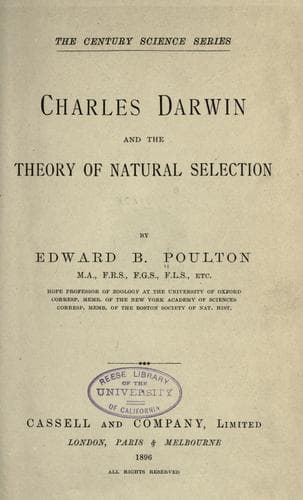
Charles Darwin and the Theory of Natural SelectionPoulton, Edward Bagnall, Sir
Science
Charles Darwin and the Theory of Natural Selection
Poulton, Edward Bagnall, Sir
Darwin, Charles, 1809-1882; Natural selection
“You will think me very self-sufficient, when I declare that I
feel _sure_ if Pangenesis is now still-born it will, thank God,
at some future time reappear, begotten by some other father,
and christened by some other name. Have you ever met with any
tangible and clear view of what takes place in generation,
whether by seeds or buds, or how a long-lost character can
possibly reappear; or how the male element can possibly affect
the mother plant, or the mother animal, so that her future
progeny are affected? Now all these points and many others are
connected together, whether truly or falsely is another question,
by Pangenesis. You see I die hard, and stick up for my poor
child.”
_To_ WALLACE, _February 27th_ [1868].
“You cannot well imagine how much I have been pleased by what
you say about ‘Pangenesis’.... What you say exactly and fully
expresses my feeling, viz. that it is a relief to have some
feasible explanation of the various facts, which can be given
up as soon as any better hypothesis is found. It has certainly
been an immense relief to my mind; for I have been stumbling over
the subject for years, dimly seeing that some relation existed
between the various classes of facts.... You have indeed pleased
me, for I had given up the great god Pan as a still-born deity.”
_To_ HOOKER, _February 28th_ [1868].
“I see clearly that any satisfaction which Pan may give will
depend on the constitution of each man’s mind.... I heard
yesterday from Wallace, who says (excuse horrid vanity), ‘I can
hardly tell you how much I admire the chapter on “Pangenesis.” It
is a _positive comfort_ to me to have any feasible explanation
of a difficulty that has always been haunting me, and I shall
never be able to give it up till a better one supplies its
place, and that I think hardly possible, &c.’ Now his foregoing
[italicised] words express my sentiments exactly and fully:
though perhaps I feel the relief extra strongly from having
during many years vainly attempted to form some hypothesis.
When you or Huxley say that a single cell of a plant, or stump
of an amputated limb, has the ‘potentiality’ of reproducing
the whole--or ‘diffuses an influence,’ these words give me no
positive idea;--but, when it is said that the cells of a plant,
or stump, include atoms derived from every other cell of the
whole organism and capable of development, I gain a distinct
idea. But this idea would not be worth a rush, if it applied to
one case alone; but it seems to me to apply to all the forms
of reproduction--inheritance--metamorphosis--to the abnormal
transposition of organs--to the direct action of the male
element on the mother plant, &c. Therefore I fully believe that
Public-domain text, read in full here on John Shaqi.
Reviews
Reviews
No reviews yet
Be the first to share your thoughts on this work.
Elsewhere in the archive
Join the Discussion
Join the discussion
Sign in to leave a comment or review.
Sign InorCreate an account