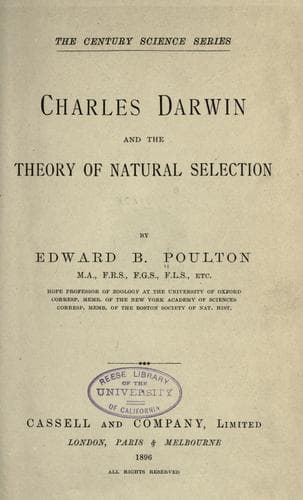
Charles Darwin and the Theory of Natural SelectionPoulton, Edward Bagnall, Sir
Science
Charles Darwin and the Theory of Natural Selection
Poulton, Edward Bagnall, Sir
Darwin, Charles, 1809-1882; Natural selection
“connects together and renders intelligible a vast number of
independent and hitherto unexplained facts. The natural system of
arrangement of organic beings, their geographical distribution,
their geological sequence, the phenomena of representative and
substituted groups in all their modifications, and the most
singular peculiarities of anatomical structure, are all explained
and illustrated by it, in perfect accordance with the vast mass
of facts which the researches of modern naturalists have brought
together, and, it is believed, not materially opposed to any of
them. It also claims a superiority over previous hypotheses, on
the ground that it not merely explains, but necessitates what
exists. Granted the law, and many of the most important facts in
Nature could not have been otherwise, but are almost as necessary
deductions from it, as are the elliptic orbits of the planets
from the law of gravitation.”
This important essay is dated by Wallace from Sarawak, Borneo,
February, 1855.
The conclusions remind us of the words Darwin wrote in his note-book in
1837. “Led to comprehend true affinities. My theory would give zest to
recent and Fossil comparative Anatomy.” By his theory Darwin here means
evolution and not natural selection, which was not discovered by him
until the end of 1838.
CHAPTER XIII.
CANON TRISTRAM THE FIRST PUBLICLY TO ACCEPT THE THEORY OF NATURAL
SELECTION (1859).
Although the historic meeting at the Linnean Society appeared to
produce but little effect, one distinguished naturalist publicly
accepted the theory of natural selection before the publication of “The
Origin of Species,” and therefore as the direct result of Darwin’s
and Wallace’s joint paper. This great distinction belongs to Canon
Tristram, as Professor Newton has pointed out in his Presidential
Address to the Biological Section of the British Association at
Manchester in 1887 (“Reports,” p. 727), at the same time expressing the
hope “that thereby the study of Ornithology may be said to have been
lifted above its fellows.”
[Sidenote: CANON TRISTRAM’S SUPPORT.]
Canon Tristram’s paper, “On the Ornithology of Northern Africa” (Part
iii., The Sahara, continued), was published in _The Ibis_, vol. i.,
October, 1859. The important conclusions alluded to above are contained
at the end of the section upon the species of desert larks (pp.
429–433):
Public-domain text, read in full here on John Shaqi.
Reviews
Reviews
No reviews yet
Be the first to share your thoughts on this work.
Join the Discussion
Join the discussion
Sign in to leave a comment or review.
Sign InorCreate an account