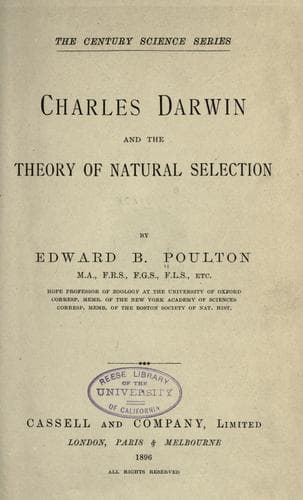
Charles Darwin and the Theory of Natural SelectionPoulton, Edward Bagnall, Sir
Science
Charles Darwin and the Theory of Natural Selection
Poulton, Edward Bagnall, Sir
Darwin, Charles, 1809-1882; Natural selection
“Writing with a series of about 100 larks of various species from
the Sahara before me, I cannot help feeling convinced of the
truth of the views set forth by Messrs. Darwin and Wallace in
their communications to the Linnean Society, to which my friend
Mr. A. Newton last year directed my attention.... It is hardly
possible, I should think, to illustrate this theory better than
by the larks and chats of North Africa. In all these birds we
trace gradual modifications of coloration and of anatomical
structure, deflecting by very gentle gradations from the ordinary
type; but when we take the extremes, presenting most marked
differences.”
These differences, he concludes--
“have a very direct bearing on the ease or difficulty with which
the animal contrives to maintain its existence.”
He then points out, upon the uniform surface of the desert it is
absolutely necessary that animals shall be protected by their colour:
“Hence, without exception, the upper plumage of every bird,
whether Lark, Chat, Sylvian, or Sandgrouse, and also the fur
of all the small mammals, and the skin of all the Snakes and
Lizards, is of one uniform isabelline or sand colour. It is
very possible that some further purpose may be served by the
prevailing colours, but this appears of itself a sufficient
explanation. There are individual varieties in depth of hue among
all creatures. In the struggle for life which we know to be going
on among all species, a very slight change for the better, such
as improved means of escaping from its natural enemies (which
would be the effect of an alteration from a conspicuous colour
to one resembling the hue of the surrounding objects), would
give the variety that possessed it a decided advantage over the
typical or other forms of the species. Now in all creatures,
from Man downwards, we find a tendency to transmit individual
varieties or peculiarities to the descendants. A peculiarity
either of colour or form soon becomes hereditary when there
are no counteracting causes, either from change of climate or
admixture of other blood. Suppose this transmitted peculiarity
to continue for some generations, especially when manifest
advantages arise from its possession, and the variety becomes not
only a race, with its variations still more strongly imprinted
upon it, but it becomes the typical form of that country.”
Public-domain text, read in full here on John Shaqi.
Reviews
Reviews
No reviews yet
Be the first to share your thoughts on this work.
Join the Discussion
Join the discussion
Sign in to leave a comment or review.
Sign InorCreate an account