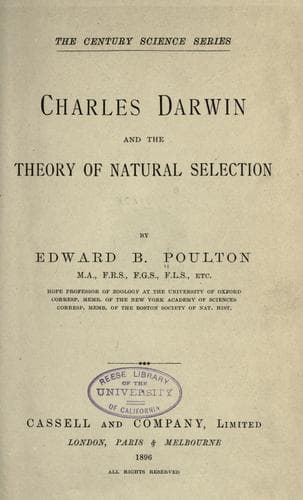
Charles Darwin and the Theory of Natural SelectionPoulton, Edward Bagnall, Sir
Science
Charles Darwin and the Theory of Natural Selection
Poulton, Edward Bagnall, Sir
Darwin, Charles, 1809-1882; Natural selection
The seventh essay, “The Coming of Age of ‘The Origin of Species,’” was
written in 1880. His complete confidence in evolution, as shown in this
essay, may be contrasted with his cautious statements about natural
selection. He boldly affirms evolution to be the fundamental doctrine
of the “Origin of Species,” while natural selection is, I believe,
neither mentioned nor even alluded to. On this great occasion he thus
emphasised the immense debt we owe to Darwin in that he was the first
to produce adequate evidence in favour of the ancient doctrine of
evolution, a benefit quite distinct from that which he conferred in the
theory of natural selection (see pp. 100–102).
The following are among the most confident statements about evolution
to be found in this essay. Speaking of the “Origin,” he says (p.
229):--
“... the general doctrine of evolution, to one side of which it
gives expression, obtains, in the phenomena of biology, a firm
base of operations whence it may conduct its conquest of the
whole realm of nature.”
And again, on page 332:--
“The fundamental doctrine of the ‘Origin of Species,’ as of all
forms of the theory of evolution applied to biology, is ‘that
the innumerable species, genera, and families of organic beings
with which the world is peopled have all descended, each within
its own class or group, from common parents, and have all been
modified in the course of descent.’”
Furthermore, on page 242 we read:--
“I venture to repeat what I have said before, that so far as the
animal world is concerned, evolution is no longer a speculation,
but a statement of historical fact. It takes its place alongside
of those accepted truths which must be reckoned with by
philosophers of all schools.”
And on the same page he quotes with approval the statement by M.
Filhol of the results to which he had been led by his palæontological
investigations:--
“Under the influence of natural conditions of which we have no
exact knowledge, though traces of them are discoverable, species
have been modified in a thousand ways: species have arisen which,
becoming fixed, have thus produced a corresponding number of
secondary species.”
Similarly, in the Obituary notice in _Nature_ (1882), Huxley speaks
of the secure position in which Darwin had placed the doctrine of
evolution as his great achievement. The following eloquent passage
occurs on page 247 of “Darwiniana”:--
“None have fought better, and none have been more fortunate, than
Charles Darwin. He found a great truth trodden underfoot, reviled
by bigots, and ridiculed by all the world; he lived long enough
to see it, chiefly by his own efforts, irrefragibly established
in science,...”
Public-domain text, read in full here on John Shaqi.
Reviews
Reviews
No reviews yet
Be the first to share your thoughts on this work.
Elsewhere in the archive
Join the Discussion
Join the discussion
Sign in to leave a comment or review.
Sign InorCreate an account