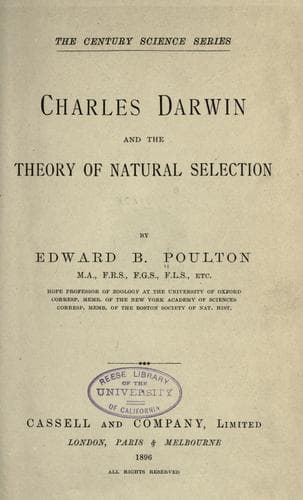
Charles Darwin and the Theory of Natural SelectionPoulton, Edward Bagnall, Sir
Science
Charles Darwin and the Theory of Natural Selection
Poulton, Edward Bagnall, Sir
Darwin, Charles, 1809-1882; Natural selection
Its value for Huxley was that it was “incomparably more probable than
the creation hypothesis”; that it was “a hypothesis respecting the
origin of known organic forms, which assumed the operation of no causes
but such as could be proved to be actually at work”; that it provided
“clear and definite conceptions which could be brought face to face
with facts and have their validity tested”; that it freed us “for ever
from the dilemma--refuse to accept the creation hypothesis, and what
have you to propose that can be accepted by any cautious reasoner?”
Indeed, the hypothesis did away with this dilemma, even if it were
itself to disappear; for “if we had none of us been able to discern
the paramount significance of some of the most patent and notorious of
natural facts, until they were, so to speak, thrust under our noses,
what force remained in the dilemma--creation or nothing? It was obvious
that, hereafter, the probability would be immensely greater, that
the links of natural causation were hidden from our purblind eyes,
than that natural causation should be incompetent to produce all the
phenomena of nature.”
Therefore, “the only rational course for those who had no other object
than the attainment of truth, was to accept ‘Darwinism’ as a working
hypothesis, and see what could be made of it.” Furthermore, “Whatever
may be the ultimate fate of the particular theory put forth by Darwin,
... all the ingenuity and all the learning of hostile critics has not
enabled them to adduce a solitary fact, of which it can be said, this
is irreconcilable with the Darwinian theory.”
Taking this argument as a whole, it seems to me to amount to the words
of Mercutio quoted at the beginning of this chapter.
In the following year (1888) Huxley wrote the Obituary Notice of
Darwin for the Proceedings of the Royal Society: it is reprinted in
“Darwiniana” (pp. 253 _et seq._). In this admirable essay the author
recognises that Darwin evidently accepted evolution before he could
offer any explanation of the motive cause by which that process
took place. The theory of descent with modification had often been
thought of before, “but in the eyes of the naturalist of the ‘Beagle’
(and, probably, in those of most sober thinkers), the advocates of
transmutation had done the doctrine they expounded more harm than
good.” Huxley speaks of the “Origin” as “one of the hardest books to
master,” in this agreeing with Hooker (see p. 111).
In this essay Huxley gives a clear and excellent statement of natural
selection, prefaced by these words (p. 287):--
Public-domain text, read in full here on John Shaqi.
Reviews
Reviews
No reviews yet
Be the first to share your thoughts on this work.
Elsewhere in the archive
Join the Discussion
Join the discussion
Sign in to leave a comment or review.
Sign InorCreate an account