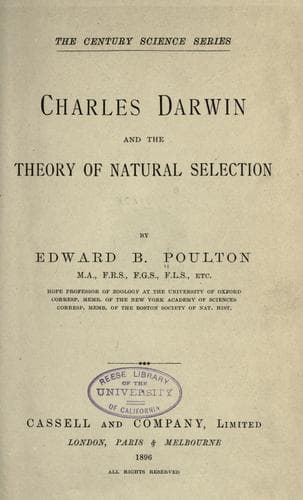
Charles Darwin and the Theory of Natural SelectionPoulton, Edward Bagnall, Sir
Science
Charles Darwin and the Theory of Natural Selection
Poulton, Edward Bagnall, Sir
Darwin, Charles, 1809-1882; Natural selection
“He has, as a matter of fact, disposed of the doctrine of the
immutability of species.... Few now are found to doubt that
animals separated by differences far exceeding those that
distinguish what we know as species have yet descended from
common ancestors.”
While thus completely admitting evolution in the organic world, Lord
Salisbury attacked natural selection on two grounds--first, on the
insufficiency of the time allowed by physicists for a process which
is, of necessity, extremely slow in its operation; secondly, on the
ground that “we cannot demonstrate the process of natural selection in
detail; we cannot even, with more or less ease, imagine it.” And his
main objection under this head was the supposed difficulty in securing
the union of successful variations. The actual words have been already
quoted on page 83, where it was shown that the criticism does not apply
to natural selection, but to a theory mistaken by the speaker for that
of Darwin. Curiously enough, the first objection of the insufficiency
of time was the indirect cause of a subsequent trenchant criticism by
Professor Perry of the line of mathematical reasoning on which the
limit had been fixed.
Huxley was called on to second the vote of thanks, and his speech had
evidently been considered with the greatest care. I quote the passages
which bear on evolution and natural selection from the _Times_ of
August 9th, 1894, in which a _verbatim_ report is furnished:--
“... As one of those persons who for many years past had made
a pretty free use of the comfortable word ‘evolution,’ let him
remind them that 34 years ago a considerable discussion, to which
the President had referred, took place in one of their sectional
meetings upon what people frequently called the ‘Darwinism
question,’ but which on that occasion was not the Darwinism
question, but the very much deeper question which lay beneath
the Darwinism question--he meant the question of evolution....
The two doctrines, the two main points, for which these men
[Sir John Lubbock, Sir J. Hooker, and the speaker] fought were
that species were mutable, and that the great variety of animal
forms had proceeded from gradual and natural modification of the
comparatively few primitive forms....”
After alluding to the revolution in thought which had taken place in
thirty-four years, he said:--
Public-domain text, read in full here on John Shaqi.
Reviews
Reviews
No reviews yet
Be the first to share your thoughts on this work.
Elsewhere in the archive
Join the Discussion
Join the discussion
Sign in to leave a comment or review.
Sign InorCreate an account