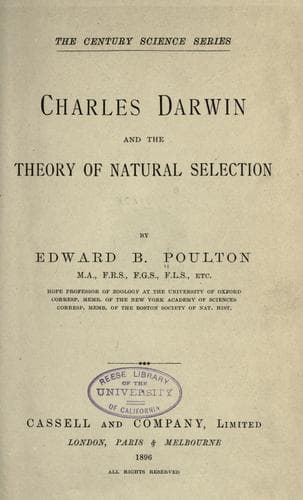
Charles Darwin and the Theory of Natural SelectionPoulton, Edward Bagnall, Sir
Science
Charles Darwin and the Theory of Natural Selection
Poulton, Edward Bagnall, Sir
Darwin, Charles, 1809-1882; Natural selection
“I fully agree with all that you say on the advantages of H.
Spencer’s excellent expression of ‘the survival of the fittest.’
This however had not occurred to me till reading your letter. It
is, however, a great objection to this term that it cannot be
used as a substantive governing a verb; and that it is a real
objection I infer from H. Spencer continually using the words,
natural selection. I formerly thought, probably in an exaggerated
degree, that it was a great advantage to bring into connection
natural and artificial selection; this indeed led me to use a
term in common, and I still think it some advantage.... The term
Natural Selection has now been so largely used abroad and at
home, that I doubt whether it could be given up, and with all its
faults I should be sorry to see the attempt made. Whether it will
be rejected must now depend ‘on the survival of the fittest.’ As
in time the term must grow intelligible the objections to its use
will grow weaker and weaker. I doubt whether the use of any term
would have made the subject intelligible to some minds, clear
as it is to others; for do we not see even to the present day
Malthus on Population absurdly misunderstood? This reflection
about Malthus has often comforted me when I have been vexed at
the mis-statement of my own views.”
A large number of critics not only failed to understand natural
selection, but they asserted that it was precisely the same theory as
that advanced by Lamarck or one of the other writers on evolution
before Darwin. This seems almost incredible to us at the present
day, when the biological world is divided into two sections on the
very subject, and when it is generally recognised that Lamarck’s
theory would be, if it were proved to be sound, a formidable rival to
natural selection as a motive cause of evolution. But the following
quotations--a few among many--leave no doubt whatever upon the subject.
Evidence on this point reached Darwin almost immediately after the
appearance of the “Origin.” Thus he writes to Hooker on December 14th,
1859:--
“Old J. E. Gray, at the British Museum, attacked me in fine
style: ‘You have just reproduced Lamarck’s doctrine, and nothing
else, and here Lyell and others have been attacking him for
twenty years, and because _you_ ... say the very same thing, they
are all coming round; it is the most ridiculous inconsistency,’
&c. &c.”
In the following year, Wilberforce, Bishop of Oxford, writing in the
_Quarterly Review_ for July, 1860, appeals to Lyell,
“in order that with his help this flimsy speculation may be as
completely put down as was what in spite of all denials we must
venture to call its twin though less-instructed brother, the
‘Vestiges of Creation.’”
Again, Dr. Bree, in “Species not Transmutable,” says:
Public-domain text, read in full here on John Shaqi.
Reviews
Reviews
No reviews yet
Be the first to share your thoughts on this work.
Elsewhere in the archive
Join the Discussion
Join the discussion
Sign in to leave a comment or review.
Sign InorCreate an account