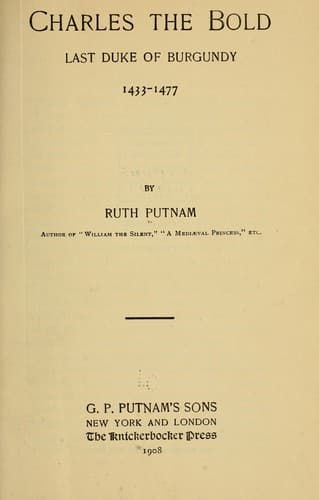
Charles the Bold, Last Duke of Burgundy, 1433-1477Putnam, Ruth
History
Charles the Bold, Last Duke of Burgundy, 1433-1477
Putnam, Ruth
Burgundy (France) -- History; Charles, Duke of Burgundy, 1433-1477; Switzerland -- History -- 1032-1499
In April, 1468, the States-General of France assembled at Tours in
response to royal writs issued in the preceding February.[2] The
chancellor, Jouvençal, opened the session with a tedious, long-winded
harangue calculated to weary rather than to illuminate the assembly.
Then the king took the floor and delivered a telling speech. With
trenchant and well chosen phrases he set forth the reasons why
Normandy ought to be an intrinsic part of the French realm. The
advantages of centralisation, the weakness of decentralisation, were
skilfully drawn. The matter was one affecting the kingdom as a whole,
in perpetuity; it was not for the temporal interests of the present
incumbent of regal authority, who had only part therein for the brief
space of his mortal journey. Louis's words are pathetic indeed, as
he calls himself a sojourner in France, _en voyage_ through life,
as though the fact itself of his likeness to the rest of ephemeral
mankind was novel to his audience. He reiterated the statement that
the interests involved were theirs, not his.
It was a goodly body which listened to Louis. The greatest feudal
lords, indeed, were not present, but many of the lesser nobility were,
while sixty-four towns sent, all told, about 128 deputies. These
hearers gave willing attention to the thesis that it was a burning
shame for the French people to pay heavy taxes simply to restrain the
insolent peers from rebelling against their sovereign--those noble
scions of the royal stock whose bounden duty it was to protect the
state and the head of the royal house.
What was the reason for their selfish insubordination? The root of the
evil lay in the past, when extensive territories had been carelessly
alienated, and their petty over-lords permitted to acquire too much
independence of the crown, so that the monarchy was threatened with
disruption. There was more to the same purpose and then the deputies
deliberated on the answer to make to this speech from the throne. It
was an answer to Louis's mind, an answer that showed the value of
suggestion. Charles the Wise had thought that an estate yielding an
income of twelve thousand livres was all-sufficient for a prince of
the blood. Louis XI. was more generous. He was ready to allow his
brother Charles a pension of sixty thousand livres. But as to the
government of Normandy--why! no king, either from fraternal affection
or from fear of war, was justified in committing that province to
other hands than his own.
The States-General dissolved in perfect accord with the monarch, and a
definite order was left in the king's hands, declaring that it was
the judgment of the towns represented that concentration of power was
necessary for the common welfare of France. Public opinion declared
that national weakness would be inevitable if the feudatories were
unbridled in their centrifugal tendencies. Above all, Normandy must be
retained by the king. On no consideration should Louis leave it to his
brother.[2]
Public-domain text, read in full here on John Shaqi.
Reviews
Reviews
No reviews yet
Be the first to share your thoughts on this work.
Elsewhere in the archive
Join the Discussion
Join the discussion
Sign in to leave a comment or review.
Sign InorCreate an account